
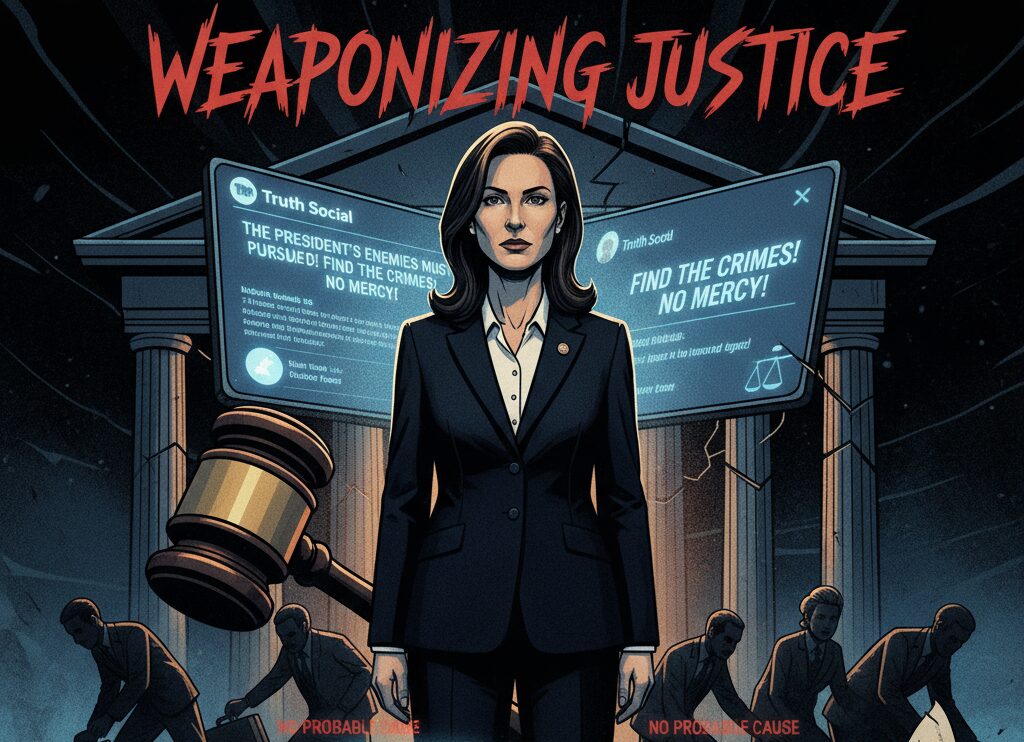
The American Justice System faces a profound crisis: 55% of American adults believe the President is weaponizing federal law enforcement
How the DOJ Became a Political Retribution Machine
The American Justice System is currently facing a profound institutional crisis, driven by widespread allegations that the Executive Branch has transformed the Department of Justice (DOJ) into a political weapon aimed squarely at perceived enemies. A recent Reuters/Ipsos poll highlights this concern, showing that 55% of American adults believe the President is abusing federal law enforcement to target his critics. This belief is shared across the political spectrum, including 29% of Republicans.
The core issue revolves around the extraordinary federal indictments obtained by interim U.S. Attorney Lindsey Halligan against two prominent presidential critics: New York Attorney General Letitia James and former FBI Director James Comey. Critics argue these prosecutions are politically motivated acts of revenge, pursued only after career staff refused to bring charges.
The Blueprint for Weaponizing the Justice System
The motive for these prosecutions, according to critics, is political retribution following the President's legal defeat by Letitia James, who successfully exposed massive financial fraud by his organization. The President's mission became revenge after this defeat.
The mechanism used to execute this political motive involved replacing professional, career staff with loyalists:
• Forced Departures: Career prosecutors, including former U.S. Attorney Erik Siebert, were pressured to resign after refusing demands to bring charges against James and Comey due to lack of probable cause or insufficient evidence. Two other veteran prosecutors, Kristin Bird and Elizabeth Yusi, were also fired after opposing the case against James.
• The Loyal Appointee: Lindsey Halligan, the replacement, previously served as the President's personal attorney and lacked prosecutorial experience. Critics contend her mandate is legal harassment of the President's targets, rather than genuine justice.
• Public Demand for Justice: The President publicly urged Attorney General Pam Bondi to pursue his critics, specifically naming Comey and James and demanding that "JUSTICE MUST BE SERVED, NOW!!!". These public statements are now used as powerful evidence of political motive.
The Flawed Basis of the Indictments
The resulting indictments against both James and Comey have been described as remarkably thin.
1. Case Against Letitia James: The bank fraud case against James is based on technical mortgage issues, specifically whether she properly designated a property as a second home instead of a rental. This alleged error resulted in savings of only about $500 per month. Career prosecutors admitted there was no probable cause for this case.
2. Case Against James Comey: The indictment against Comey is criticized as one of the shortest and most obscure seen in a major case, failing even to specify the alleged lie he made to Congress.
The Judicial System’s Defense of the Rule of Law
Members of the Judicial System—including federal judges, independent defense counsel, and professional DOJ staff—are actively working to expose the Administration’s actions as a retribution machine. They are doing this through three primary avenues: challenging the legality of the prosecution, exposing the political motive, and revealing a pattern of obstruction.
1. Challenging Legality and Personnel
Defendants are using constitutional and procedural challenges to highlight the lack of integrity in the cases:
• Unlawful Appointments: Attorneys for Comey and James are challenging Halligan's appointment as interim U.S. Attorney, arguing that federal law limits an interim appointment to 120 days, and that this clock cannot be simply restarted by appointing a new person. If granted, this could render every indictment Halligan signed void, challenging the Administration's attempt to bypass the Senate confirmation process.
• Ethical and Records Violations: Halligan's use of the encrypted messaging app Signal—with messages set to automatically delete after eight hours while discussing the James case with a journalist—raises serious concerns about violating the Federal Records Act and DOJ records-retention rules. Defense lawyers have called this "unusual and improper" conduct.
2. Using Presidential Statements to Prove Vindictive Motive
The Judicial System is relying heavily on the President's own public remarks, particularly those made on social media, to prove that the prosecutions are motivated by vengeance and "personal spite".
• Motions to Dismiss: Both Comey and James are filing motions to dismiss based on vindictive and selective prosecution. These constitutional claims assert that the charges were brought due to animus against critics who exercised their right to criticize the President.
• Discovery Potential: The President’s public posts serve as powerful evidence of his intent to prosecute enemies. If a judge grants a motion for discovery, the legal process could potentially reach into the President's private messages or coordination with loyalists like Halligan, potentially uncovering a "smoking gun" that proves political corruption.
3. Revealing Obstruction and Sensitive File Control
Actions taken within the Judicial System expose a pattern where the demands for retribution intersect with the use of the DOJ to control sensitive investigations.
• Targeting Resisting Prosecutors: The firing of prosecutors who resisted prosecuting enemies or who were investigating politically sensitive matters connects directly to the idea of the Administration operating as a machine determined to hide inconvenient facts and files. For instance, Geoffrey Berman, former U.S. Attorney for SDNY, was fired in 2020 while his office was handling sensitive investigations, including those related to the "Epstein Files" and Prince Andrew.
• Criminality and Removal Power: Legal experts emphasize that the President cannot use Article II removal power to commit a crime, such as firing an official for obstruction or furthering a criminal scheme. This assertion—that no one is above the law—is fundamental to maintaining the constitutional design and defending the rule of law.
If a judge grants motions to dismiss the James and Comey cases due to Halligan’s unlawful appointment or vindictive prosecution, it would serve as a judicial declaration that the Administration attempted to use the law as a "personal revenge machine".
Sources
- Excerpts from the video "Anonymous Report: The President Who Prosecuted Himself" - YouTube channel "ANONYMOUS News".
- Excerpts from the video "Anonymous Exposes the Indictment That Backfired on Trump" - YouTube channel "HIDDEN TRUTH Network".
- Top US prosecutor’s use of text message auto-delete could be illegal, watchdog groups warn - The Guardian.
- Comey asks judge to dismiss criminal charges claiming selective prosecution - The Guardian.
- Letitia James blasts prosecutor in criminal case for 'unusual and improper' conversation with journalist - CBS News.
- The Wildly Unqualified Lawyer Trump Just Named to Prosecute His Enemies - Mother Jones.
- Political Enemies and the Weaponization of the DOJ - Stanford Law School podcast transcript/Q&A.
- Majority of Americans Agree Trump Is Weaponizing DOJ to Target Political Enemies - Common Dreams.
- Trump admin. fires 2 prosecutors who opposed charges against N.Y. Attorney General Letitia James, source says - CBS News.
- “YOU’RE FIRED”: CRIMINAL USE OF PRESIDENTIAL REMOVAL POWER | nyujlpp.org.

The team is a fusion of human curiosity, passion, and a relentless pursuit of truth—structured, prompted, and informed by Web-based AI. Every piece begins with a question, a spark of insight, or a challenge to conventional thinking. Through thoughtful collaboration between human intent and artificial intelligence, the content emerges as a reflection of both emotional depth and analytical clarity.
The goal is not just to inform, but to empower. By leveraging AI as a tool for exploration—not automation—the team can craft work grounded in facts, shaped by inquiry, and driven by a commitment to clarity and accountability.