

The U.S. healthcare crisis demands a transition to a single-payer system to eliminate medical debt and guarantee care for all Americans.
The Hidden Cost of the Status Quo
The United States remains the only wealthy, industrialized nation that treats healthcare as a privilege rather than a fundamental human right. While Americans navigate a labyrinth of private insurers, high deductibles, and "out-of-network" traps, our peer nations have proven that a different path is possible. The moral failures of our current system are never more apparent than in the aftermath of tragedy. Following recent mass casualty events, survivors are often forced to rely on crowdfunding to pay for life-saving surgeries. This reality stands in stark contrast to nations where Universal Healthcare Benefits ensure that no victim of violence or illness is met with a bill for their survival. It is time for Congress to pass H.R. 3421, the Medicare for All Act, to finally align American policy with human dignity.
Policy Summary: H.R. 3421 and the Medicare for All Act
The Medicare for All Act (H.R. 3421), sponsored by Representative Pramila Jayapal (D-WA), proposes a comprehensive overhaul of the American healthcare delivery system. The bill seeks to establish a federally funded, single-payer program that provides every resident of the United States with high-quality care without out-of-pocket costs at the point of service.
Key Provisions of the Bill Include:
- Comprehensive Coverage: Includes primary care, emergency services, dental, vision, mental health, and prescription drug coverage.
- Elimination of Cost-Sharing: Removes all premiums, deductibles, and co-pays, which are currently rising at an unsustainable rate of 6% annually for family plans.
- Negotiation Power: Empowers the Department of Health and Human Services (HHS) to negotiate drug prices directly with pharmaceutical companies.
The Global Contrast: Bondi Beach vs. American Tragedy
In December 2025, a tragic mass shooting at Bondi Beach, Australia, tested that nation's healthcare infrastructure. Because Australia utilizes a tax-funded national system, survivors like Ahmed Al Ahmed received world-class surgical care without incurring a single cent in medical debt. In the United States, however, victims of similar tragedies routinely launch GoFundMe campaigns to cover intensive care costs. This "GoFundMe Safety Net" is a policy choice, not an inevitability.
Opposing Arguments: The Case for Competition
Critics of a single-payer system, primarily representing the insurance and pharmaceutical industries, argue that a transition to universal coverage would lead to:
- Increased Taxation: Opponents argue that the federal spending required would necessitate significant tax hikes on the middle class.
- Longer Wait Times: Some suggest that removing cost barriers would overwhelm the system, leading to delays for elective procedures.
- Loss of Choice: Critics maintain that Americans value the "choice" provided by the private employer-sponsored market, which currently covers over 150 million people.
Core Analysis: The Economic Reality of Universal Healthcare Benefits
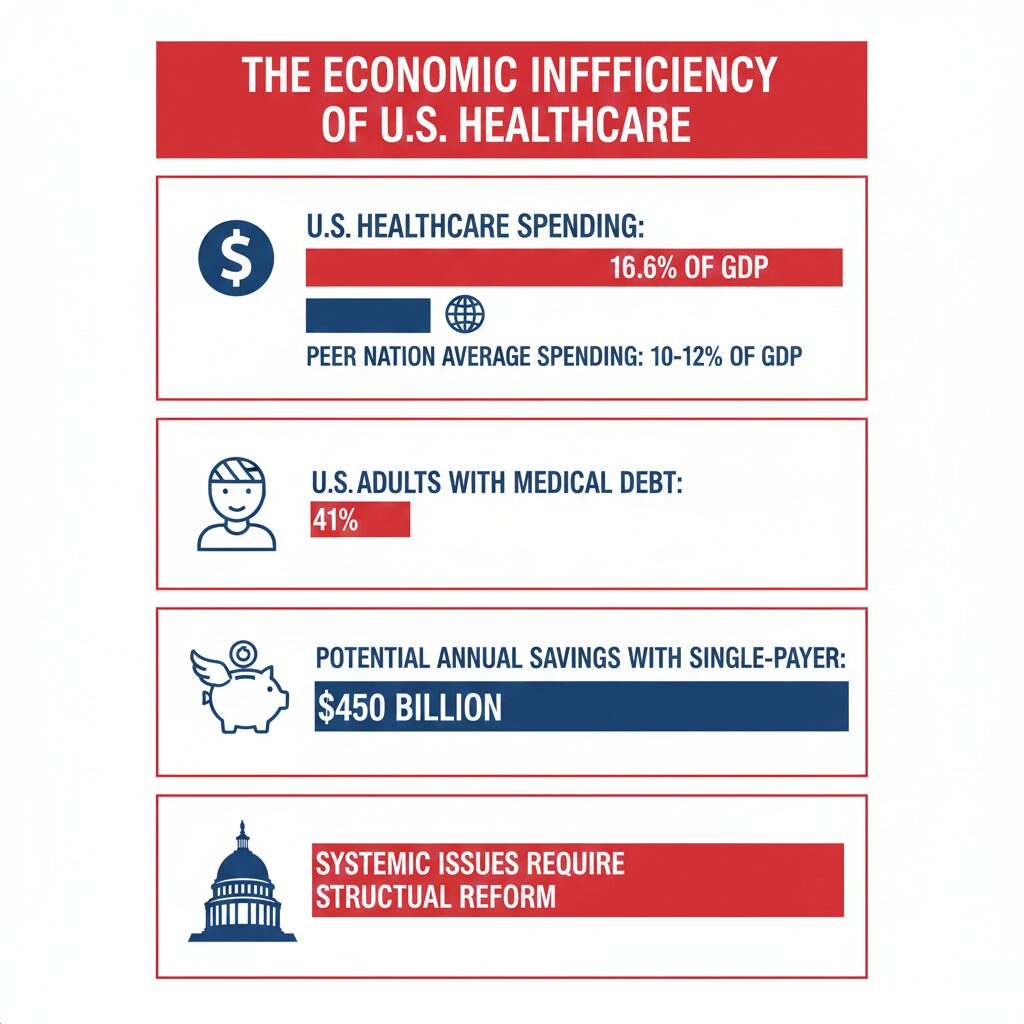
The argument that we "cannot afford" universal care is mathematically hollow. Data from the Commonwealth Fund’s Mirror, Mirror 2024 report confirms that the United States spends nearly 17% of its GDP on healthcare—far more than any other nation—yet ranks last among 10 high-income peers in access, equity, and outcomes.
The true "cost" of our current system includes:
- Administrative Waste: Private insurers spend billions on billing, marketing, and executive bonuses—costs that do not exist in a single-payer model.
- Medical Bankruptcy: Nearly 41% of U.S. adults are currently burdened by medical debt, a leading cause of bankruptcy that is virtually non-existent in Australia or the UK.
- The "Uninsured" Death Toll: Thousands of Americans die annually simply because they cannot afford to see a doctor before a condition becomes terminal.
By centralizing the payment system, Universal Healthcare Benefits would realize an estimated $350 billion to $450 billion in annual savings by eliminating the middleman. Furthermore, decoupling health insurance from employment would empower workers, allowing for greater labor mobility and supporting small businesses currently crushed by rising premium costs.
Conclusion: A Call to Human Rights
The choice before Congress is not merely one of economics, but of character. We can continue to allow private corporations to profit from illness, or we can join the rest of the developed world in guaranteeing care. We must demand that our representatives co-sponsor H.R. 3421 and move the bill out of the Subcommittee on Health.
Call to Action: Contact your Representative today. Demand that they prioritize people over profits and support the Medicare for All Act.
Sources
- H.R. 3421 - Medicare for All Act of 2023 - [Congress.gov]
- 2025 Employer Health Benefits Survey - [KFF]
- Mirror, Mirror 2024: A Portrait of the Failing U.S. Health System - [Commonwealth Fund]
- Bondi Beach Hero Receives Donations After Australia Shooting - [CBS News]

The team is a fusion of human curiosity, passion, and a relentless pursuit of truth—structured, prompted, and informed by Web-based AI. Every piece begins with a question, a spark of insight, or a challenge to conventional thinking. Through thoughtful collaboration between human intent and artificial intelligence, the content emerges as a reflection of both emotional depth and analytical clarity.
The goal is not just to inform, but to empower. By leveraging AI as a tool for exploration—not automation—the team can craft work grounded in facts, shaped by inquiry, and driven by a commitment to clarity and accountability.