

Ohio’s 2025 local elections signal a progressive shift as suburban voters reject extremism, leading many to ask: is Purple Turns Blue? a new reality?
A New Dawn in the Buckeye State
For years, pundits have prematurely penned the obituary of Ohio as a swing state, labeling it "solid red" after recent cycles. However, the 2024 and 2025 election data suggests a far more complex reality. While the top of the ticket in 2024 remained a Republican stronghold, the underlying movement in municipal councils and school boards tells a different story. As local communities mobilize against restrictive state-level policies, a critical question emerges for the 2026 midterms: Is Purple Turns Blue? not just a hopeful slogan, but a documented trend in the state’s changing demographics?
Policy Summary: The Tug-of-War for Ohio’s Future
At the heart of Ohio's political tug-of-war are two competing visions: a Republican-led legislature focused on consolidating power through redistricting and restrictive voting laws, and a citizen-led movement using ballot initiatives to protect direct democracy.
In late 2025, the Ohio Redistricting Commission unanimously approved a new congressional map. While the bipartisan agreement was hailed as a "compromise," progressive advocates point out that it remains a subtle gerrymander. The map potentially increases the GOP's share to 12 of 15 seats, despite the state's more balanced popular vote. Conversely, progressives have successfully utilized the ballot box to codify reproductive rights and marijuana legalization, proving that when policy is separated from partisan labels, Ohioans lean toward progressive values.
Arguments Against the Progressive Shift
Critics of the "blue shift" narrative argue that Ohio’s rightward trend at the federal level is a permanent realignment. They point to Donald Trump’s double-digit victory in 2024 and the unseating of long-time Democratic Senator Sherrod Brown as evidence that the state’s "Blue Wall" has crumbled. Conservative analysts suggest that municipal victories in 2025 are merely "islands of blue" in a vast sea of red, driven by local issues rather than a rejection of the GOP platform.
Analysis & Rebuttal: Why Purple Turns Blue? Is the Real Narrative
The data from the November 2025 local elections provides a powerful rebuttal to the "Permanently Red" theory. While the state legislature remains under a GOP supermajority, the grassroots level is seeing a seismic shift.
Evidence of the Suburban Realignment
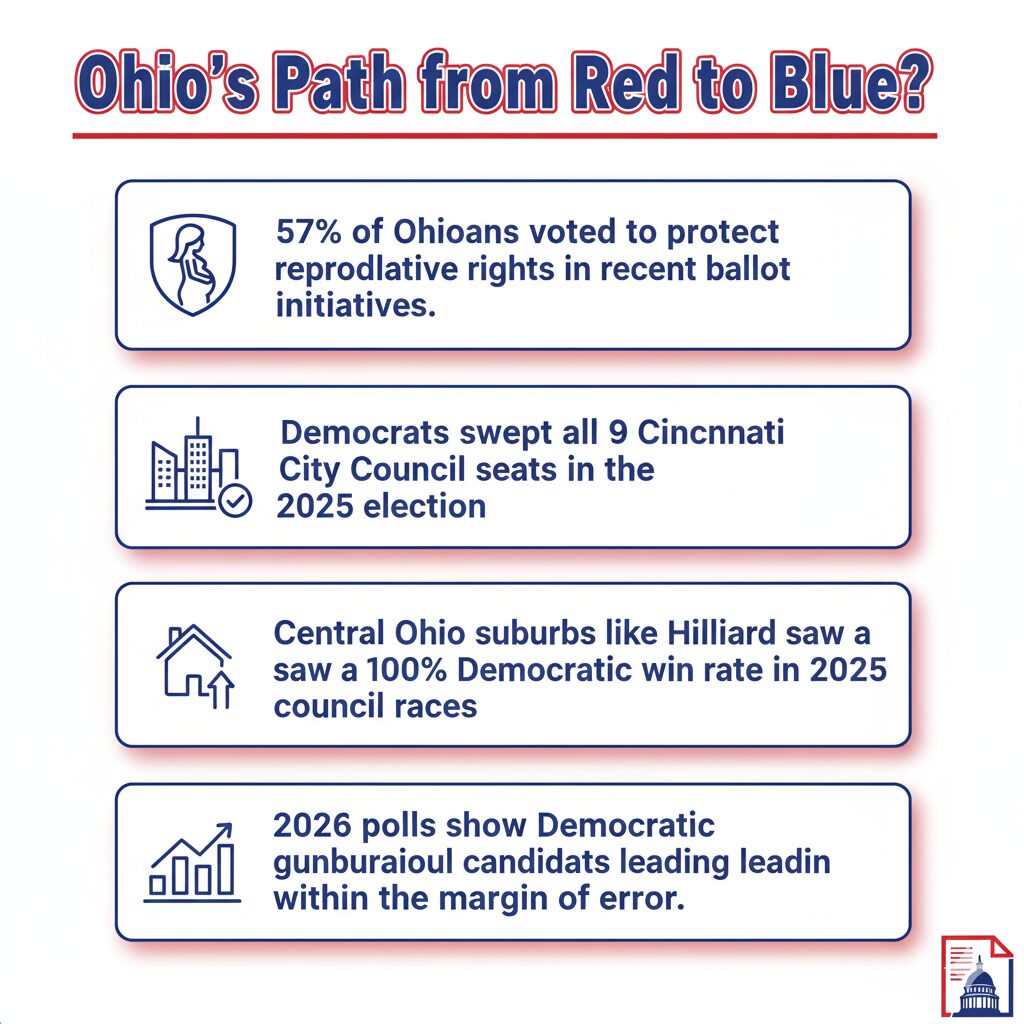
In the 2025 cycle, Democrats scored significant victories across suburban strongholds that were once considered the GOP's reliable base. In Cincinnati, Mayor Aftab Pureval secured a commanding victory, and Democrats swept all nine seats on the city council. Perhaps more telling was the performance in traditionally conservative central Ohio suburbs like Hilliard and Upper Arlington, where Democratic candidates won nearly all contested seats.
This shift is driven by a "cosmopolitan versus traditionalist" divide. As Ohio's urban and suburban centers grow—particularly the "Intel-fueled" boom in the Columbus region—the electorate is becoming younger, more diverse, and more college-educated. These voters are increasingly alienated by the state legislature’s focus on social "culture wars" over economic stability and infrastructure.
The Impact of Direct Democracy
The most significant evidence that Ohio remains a battleground lies in the success of citizen-led initiatives. In 2023 and 2024, Ohioans repeatedly rejected Republican attempts to raise the threshold for constitutional amendments and voted decisively for reproductive freedom. This disconnect between what the people want and what the legislature passes is fueling a new wave of engagement.
"The success of progressive ballot measures in a state Trump won twice proves that the problem isn't the voters—it's the maps," notes a recent legislative analysis on theCitizens Not Politiciansinitiative.
Conclusion: Organizing for 2026
The narrative that Ohio is "gone" for progressives ignores the vibrant, successful organizing happening in every corner of the state. The 2025 results show that when we focus on local governance and protecting the "People’s Tool" of the ballot initiative, we win.
The path to 2026 requires maintaining this momentum. We must continue to challenge gerrymandered maps and support candidates who reflect the true diversity of the Buckeye State.
Call-to-Action: Get involved today. Join your local county Democratic party or a non-partisan redistricting advocacy group to ensure every Ohioan's voice is heard in the 2026 midterms.
Sources
- 2024 Ohio Election Results - AP News
- Ohio Politics Update: Insights from the 2025 Local Elections - Bricker Graydon LLP
- Ohio 2026 Poll: Democrats Make Gains - Emerson College Polling
- Progressive Ohio Ballot Initiative Passage - John Carroll University
- Ohio Adopts New Congressional Map - Democracy Docket

The team is a fusion of human curiosity, passion, and a relentless pursuit of truth—structured, prompted, and informed by Web-based AI. Every piece begins with a question, a spark of insight, or a challenge to conventional thinking. Through thoughtful collaboration between human intent and artificial intelligence, the content emerges as a reflection of both emotional depth and analytical clarity.
The goal is not just to inform, but to empower. By leveraging AI as a tool for exploration—not automation—the team can craft work grounded in facts, shaped by inquiry, and driven by a commitment to clarity and accountability.