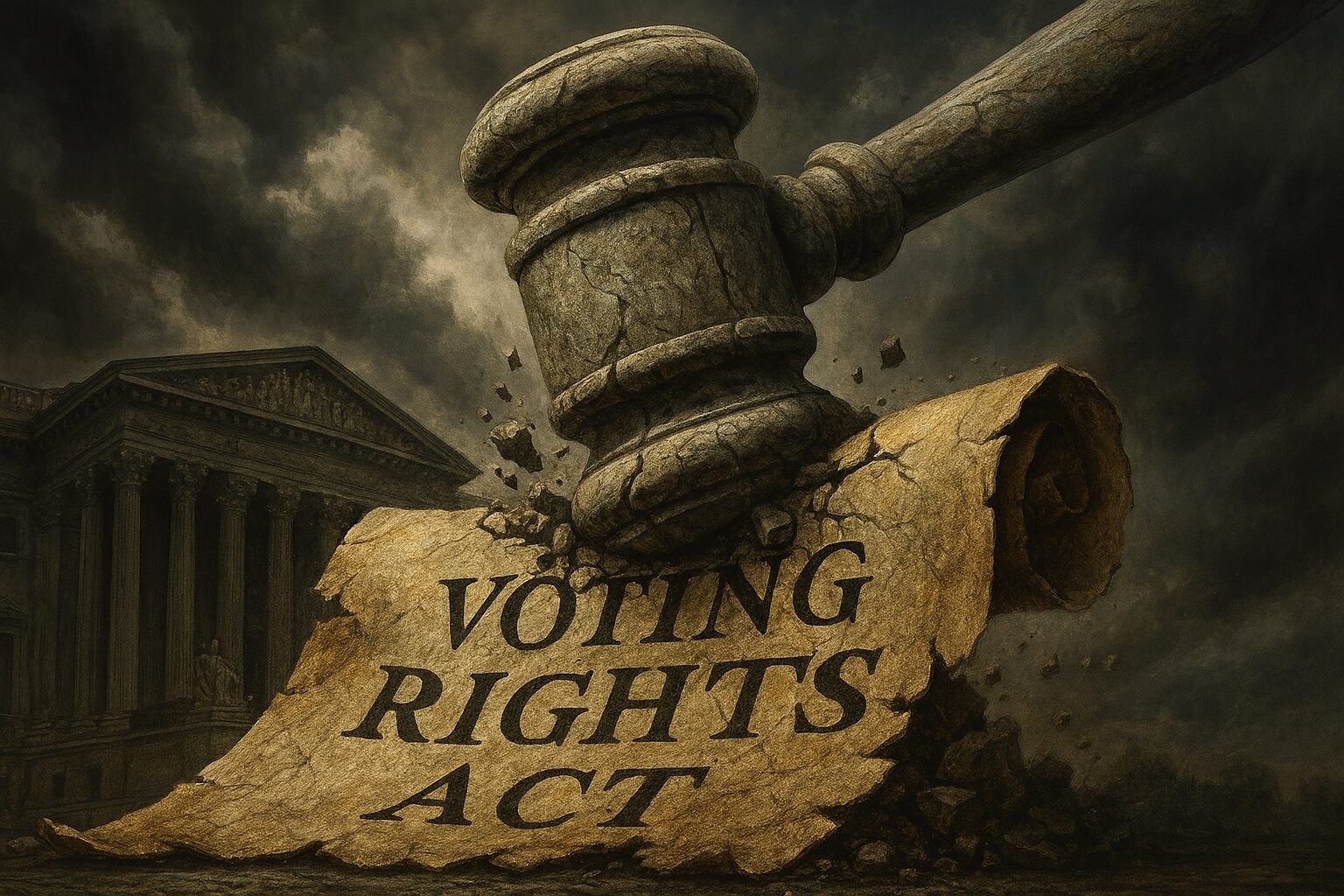
The U.S. Supreme Court is actively dismantling the Voting Rights Act, demanding immediate legislative action to protect the fundamental right to vote.
The bedrock principle of American democracy—one person, one vote—is under coordinated, sustained attack. This month, news cycles have been dominated by the U.S. Supreme Court's deliberations and lower court rulings on cases that scrutinize the very core of the Voting Rights Act (VRA) of 1965. For decades, the VRA has stood as a bulwark against racial discrimination in electoral processes. However, a series of judicial decisions, culminating in the current legal landscape, demonstrates that the fundamental terms of how Americans exercise their franchise are rapidly being redefined. The landscape of Voting Rights Changed significantly following the Court’s 2013 ruling in Shelby County v. Holder, and the current term threatens to fully eviscerate the law’s most vital remaining provision: Section 2. From a progressive advocacy standpoint, these judicial and legislative assaults are a deliberate effort to dilute minority political power and necessitate an urgent and comprehensive federal response.
Policy Summary: The VRA and Its Critics
The Voting Rights Act of 1965 is widely regarded as the most effective civil rights legislation in American history. Its core provisions, particularly Section 5 (which required jurisdictions with a history of discrimination to preclear voting changes with the federal government) and Section 2 (which prohibits voting practices that result in the denial or abridgment of the right to vote on account of race or color), were instrumental in dismantling Jim Crow-era restrictions.
The major legal shift occurred in Shelby County v. Holder, where the Supreme Court, through a 5-4 decision, invalidated the formula used to determine which jurisdictions were subject to Section 5 preclearance. This decision functionally rendered Section 5 unenforceable. The predictable result was an immediate wave of restrictive voting laws—including voter ID requirements, restrictions on mail-in ballots, and aggressive voter purges—enacted primarily in states previously covered by preclearance.
The current focus is on Section 2, which allows voters and civil rights groups to challenge discriminatory voting practices, such as racially biased redistricting, after they have been enacted. The Supreme Court has recently heard arguments, notably in Louisiana v. Callais, that question the very constitutionality and scope of Section 2, with conservative justices expressing skepticism about the necessity of race-conscious remedies in drawing legislative maps.
Opposing Arguments
Opponents of the VRA's strong enforcement, particularly in the context of redistricting, argue primarily for a shift toward color-blind criteria and state autonomy. Their core claims are:
- Obsolete Necessity: They argue that the racial conditions of 1965 no longer exist, and therefore, race-specific protections like Section 2 are an unnecessary and overreaching federal intrusion into states’ rights to manage their own elections, which is protected by the Constitution.
- Partisan vs. Racial Gerrymandering: They contend that many challenges filed under Section 2 are, in reality, complaints about partisan gerrymandering, which the Supreme Court has previously deemed a "political question" not suitable for federal judicial review. They assert that it is difficult and improper for courts to disentangle racial intent from political affiliation, especially where race and party preference are closely correlated.
- Preventing Racial Sorting: A further argument posits that Section 2 mandates the intentional drawing of districts based on race, which critics view as a form of racial gerrymandering that should be prohibited.
Progressive Critique and The Need for Federal Intervention
The progressive view holds that the opponents' arguments are not only legally flawed but are actively detrimental to the functioning of a truly representative democracy. Data overwhelmingly demonstrates that the need for VRA protections is as critical as ever, underscoring why the debate over Voting Rights Changed must pivot back to Congress.
The De Facto Discrimination of Partisan Maps
The argument that Section 2 challenges are merely partisan thinly veils the reality of racial vote dilution. In states with histories of discriminatory practices, race remains a powerful predictor of political preference. When map drawers intentionally pack or crack communities of color—a practice known as gerrymandering—the effect is to dilute the electoral power of minority voters. This is the very essence of what Section 2 was designed to prevent. Recent court actions, such as the temporary block on a lower court finding that the Texas congressional map was likely a racial gerrymander, reinforce the concern that the judicial system is increasingly prioritizing political advantage over the substantive protections of minority representation.
Restoring Preclearance: The Only Path
The most compelling data point for progressive advocacy is the surge of restrictive voting laws following the Shelby County decision. Studies have shown a significant increase in the racial turnout gap in the jurisdictions once covered by Section 5, directly contradicting the notion that the VRA is obsolete. To restore the health of American democracy, Congress must pass legislation such as the John R. Lewis Voting Rights Advancement Act (H.R. 4, or similar bills), which would modernize and revitalize the VRA by establishing a new, functional preclearance formula.
This new formula would require states and localities with a recent, verifiable history of voting rights violations to once again submit certain proposed changes to the Department of Justice (DOJ) or a federal court before implementation. This legislative action would be a necessary legislative reassertion of the fundamental right to vote, effectively repairing the damage caused by the Supreme Court’s judicial activism. The time for Congress to act on the imperative of ensuring Voting Rights Changed for the better, not the worse, is now.
The Threat to Section 2
Progressive advocates are deeply alarmed by the Supreme Court's consideration of the Louisiana v. Callais case. Should the Court further restrict the use of race as a factor in drawing districts to remedy discrimination, it would remove the most potent legal tool currently available to combat vote dilution. Stripping Section 2 of its force would embolden states to draw extreme, discriminatory maps with impunity, leading to legislative bodies that do not accurately reflect the racial and ethnic composition of their constituents. The impact would not merely be political; it would fundamentally undermine the promise of the Fifteenth Amendment.
Conclusion and Call-to-Action
The judiciary’s recent trajectory, coupled with a concerted effort by conservative political forces to implement restrictive voting policies, signals a democratic crisis. The Voting Rights Changed landscape is one of diminishing protections and emboldened suppressive tactics. From a progressive perspective, the fight for the right to vote must shift decisively to the legislative arena.
The most powerful action is for citizens to demand that their representatives—particularly those in the Senate—support and pass the John R. Lewis Voting Rights Advancement Act. This legislation is not merely symbolic; it is the comprehensive, data-driven remedy required to restore the VRA’s preclearance power and strengthen Section 2, ensuring that every citizen, regardless of race or background, has an equal opportunity to participate in the democratic process. Contact your Senators today and urge them to end the legislative inertia that allows the erosion of the VRA to continue.
Sources
- Federal Court Greenlights North Carolina’s Trump-Ordered Gerrymander - Democracy Docket
- Supreme Court allows Texas congressional map favoring GOP, for now - The Washington Post
- The Voting Rights Act Is Still Working To Stop Racist Laws. The Supreme Court Might Not Care. - Democracy Docket
- Strengthening the Voting Rights Act - Brennan Center for Justice
- After Voting Rights Act case arguments, concerns over diminished minority representation rise - Associated Press

The team is a fusion of human curiosity, passion, and a relentless pursuit of truth—structured, prompted, and informed by Web-based AI. Every piece begins with a question, a spark of insight, or a challenge to conventional thinking. Through thoughtful collaboration between human intent and artificial intelligence, the content emerges as a reflection of both emotional depth and analytical clarity.
The goal is not just to inform, but to empower. By leveraging AI as a tool for exploration—not automation—the team can craft work grounded in facts, shaped by inquiry, and driven by a commitment to clarity and accountability.