
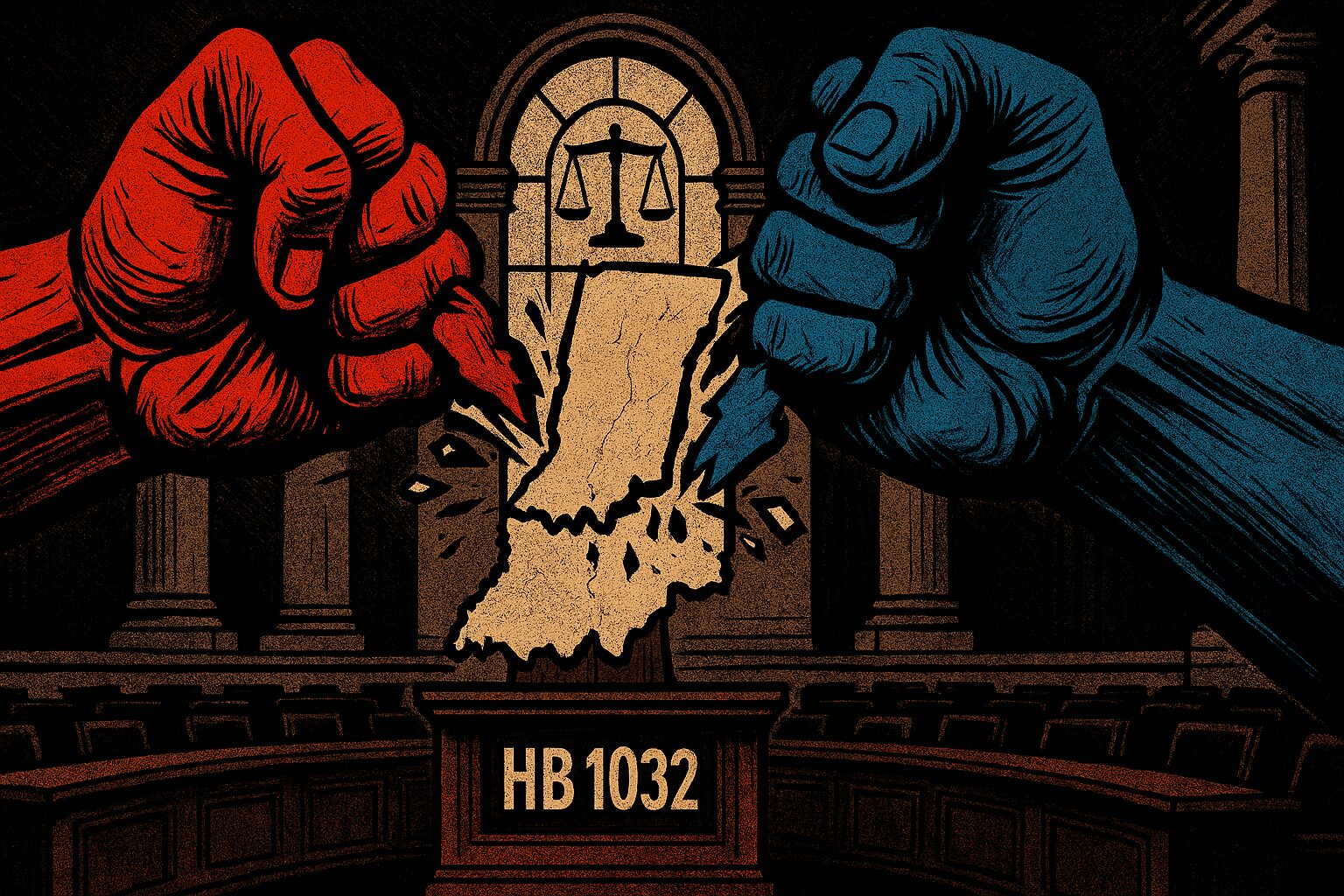
Indiana's push to redraw its congressional map mid-cycle is a mid-term redistricting bonanza and violates the spirit of a representative government.
The bedrock of American democracy relies on the principle of one person, one vote. Yet, in the shadows of the Supreme Court's controversial decision allowing Texas to use its newly drawn congressional map—a ruling critics argue disregards evidence of racial gerrymandering—Indiana's legislature has initiated its own Mid-Term Redistricting Bonanza. This move, spearheaded by a legislative supermajority and codified in proposed legislation like House Bill 1032 (HB 1032), seeks to redraw the state’s congressional districts just two years after the decennial census, a blatant attempt to maximize partisan advantage for the 2026 mid-term elections. Framed by a Progressive Advocacy lens, this article asserts that this extraordinary mid-cycle maneuver constitutes an unconscionable violation of the public trust and the fundamental duty of elected officials to serve all constituents, not merely a political faction.
Policy Summary: A Power Grab Disguised as Legislation
Redistricting, the process of redrawing electoral maps, is traditionally a once-a-decade event following the U.S. Census. The current legislative effort in Indiana seeks to disrupt this established cycle. The proposed maps are designed to dismantle the state's two currently Democratic-held U.S. House seats, aiming for an unprecedented 9-0 Republican sweep of the state's congressional delegation. Critically, this legislative push is not just about drawing new lines; the proposal includes language that seeks to legalize mid-census redistricting and, more alarmingly, attempts to restrict the public’s ability to challenge the new map in state courts by banning temporary restraining orders.
The Opposition's Rationale
Proponents of mid-cycle redistricting often frame their action as a necessary political counter-move to actions taken by other states, or as a way to "clean up" or "correct" perceived imbalances in the existing map. For instance, some argue that if Democratic-controlled states engage in partisan map-drawing, the only way to ensure national party parity is for Republican-controlled states to do the same. They rely on the Supreme Court’s 2019 ruling in Rucho v. Common Cause, which held that federal courts have no jurisdiction over claims of partisan gerrymandering, essentially granting political parties a judicial pass for this activity. From this perspective, drawing a map "purely for political performance," as the author of Indiana’s bill stated in a committee hearing, is simply engaging in permissible, competitive politics.
The Progressive Analysis & Rebuttal: Violating the Oath of Office
The Progressive view holds that partisan gerrymandering, especially a mid-cycle attempt like this, is a sophisticated form of voter suppression that undermines the foundational integrity of the American democratic experiment. When a legislative body chooses its voters rather than the reverse, it renders elections meaningless, dampens voter turnout, and strips minority communities of their political voice.
The Betrayal of the Oath
Every state representative takes an oath to support the Constitution and faithfully discharge the duties of their office. This duty, in a democratic republic, must extend beyond simple fealty to one's political party. The push for a Mid-Term Redistricting Bonanza actively violates the spirit of this oath by targeting specific constituents for political marginalization. By redrawing maps to dilute the voting strength of the minority party and communities of color—particularly in heavily minority-populated areas like Marion County, which the proposed map carves into four separate districts—lawmakers are prioritizing partisan self-interest over the constitutional principles of equal representation and justice.
This practice is often described as minority vote dilution, a direct challenge to the equal opportunity to elect candidates of choice, which is protected under Section 2 of the Voting Rights Act of 1965 (VRA). The legislative rush, evidenced by the House holding its only public hearing with less than a day's notice, further suggests a deliberate attempt to evade public scrutiny and bypass robust legislative debate.
The Dangerous Precedent
The aggressive pursuit of a 9-0 map in Indiana, following the Supreme Court's effective green light to the Texas map, establishes a dangerous national precedent. This mid-cycle redrawing escalates the practice of partisan warfare, shifting the battleground from policy debates to cartographical manipulation. It weaponizes the redistricting process, making elections less about public service and more about the technical drafting of boundaries. This focus on "packing" and "cracking" specific populations makes it nearly impossible for voters to hold their representatives accountable, which is a structural decay of representative government itself.
Conclusion
The Mid-Term Redistricting Bonanza in Indiana is a profound moral and ethical failure by those entrusted with the legislative process. It is a cynical attempt to lock in political power for a single party by systematically diluting the voices of others, particularly minority voters. This action does not advance good governance; it only advances a corrosive political ambition that treats the right to vote as a spoils system rather than a sacred constitutional principle.
Call-to-Action: Citizens must demand that their state senators uphold the integrity of the democratic process and reject any effort to pass HB 1032. Contact your state representatives and insist they honor their oath by opposing mid-cycle redistricting and supporting a constitutional amendment for an independent, non-partisan redistricting commission.
Sources
- Indiana lawmakers convene with redistricting top of mind - PBS News
- Supreme Court allows Texas to use redistricting map challenged as racially discriminatory - SCOTUSblog
- House panel advances Indiana map drawn ‘purely for political performance’ of GOP - Mirror Indy
- Indiana Republicans Unveil Map to Eliminate Both Dem Congressional Seats - Democracy Docket
- Mid-Decade Congressional Redistricting: Key Issues - Congress.gov CRS Report

The team is a fusion of human curiosity, passion, and a relentless pursuit of truth—structured, prompted, and informed by Web-based AI. Every piece begins with a question, a spark of insight, or a challenge to conventional thinking. Through thoughtful collaboration between human intent and artificial intelligence, the content emerges as a reflection of both emotional depth and analytical clarity.
The goal is not just to inform, but to empower. By leveraging AI as a tool for exploration—not automation—the team can craft work grounded in facts, shaped by inquiry, and driven by a commitment to clarity and accountability.