
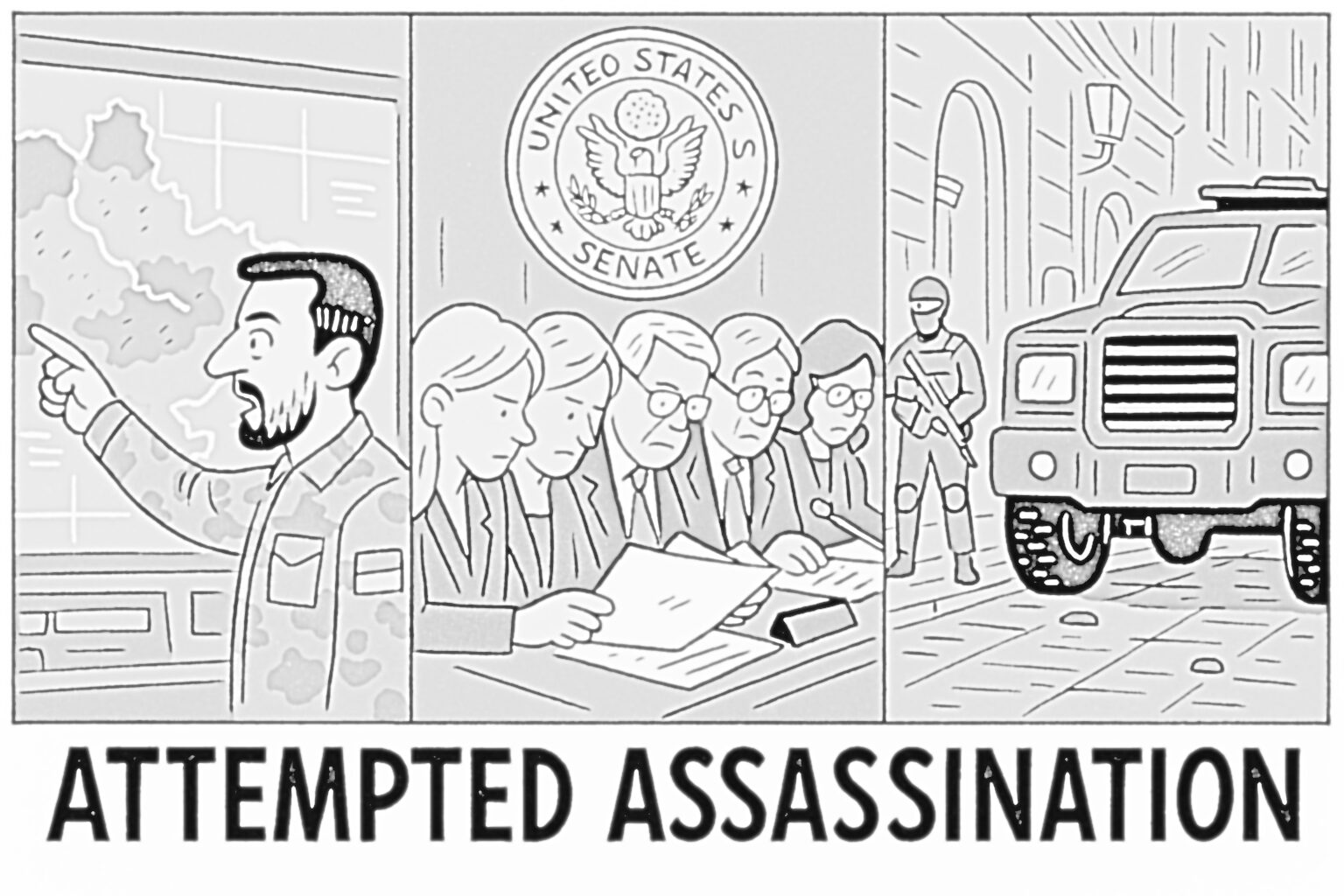
The latest attempted assassination plot on Ukraine's President Zelenskyy prompts a crucial Congressional review of security protocols and aid strategies.
The continuous stream of threats against Ukrainian President Volodymyr Zelenskyy, highlighted by the most recent foiled attempted assassination plot, demands a comprehensive and bipartisan re-evaluation of the United States' commitment to Kyiv's security. This article, adhering to a Non-Partisan Analysis LENS, examines the legislative response in Washington, focusing on the congressional implications for security assistance and oversight measures. The persistent targeting of a democratic ally's head of state is not merely a foreign intelligence matter; it is a direct challenge to the rules-based international order that has historically drawn a strong, unified response from the U.S. Congress. The stability of Ukraine’s government is inextricably linked to the success of U.S. and allied policy, making this security threat a critical national interest.
Policy Summary: The Threat Landscape and U.S. Response
Multiple sources, including Ukrainian security services (SBU) and allied intelligence agencies like Poland's Internal Security Agency, have documented numerous plots against President Zelenskyy since the full-scale Russian invasion began. These plots, often attributed to Russia's Federal Security Service (FSB) or affiliated mercenary groups, range from infiltration by highly trained operatives to intelligence-gathering intended to guide drone or sniper attacks at critical logistical hubs. For instance, reports indicate a foiled April 2024 plot in Poland aimed at gathering intelligence on the Rzeszów-Jasionka Airport, a key entry point for Western military aid.
Opposing Arguments and Domestic Scrutiny
While the desire to support Ukraine against unprovoked aggression remains a bipartisan consensus, the scale and nature of U.S. aid have faced increasing domestic scrutiny, particularly from legislators concerned with accountability. Arguments against expanding security assistance often center on two primary areas:
- Oversight and Accountability: Critics argue that the vast sums appropriated for Ukraine lack sufficient oversight, citing instances where the Department of Defense (DOD) miscalculated the valuation of previously provided defense articles under Presidential Drawdown Authority (PDA). Legislation like H.R. 5692, the Ukraine Security Assistance and Oversight Supplemental Appropriations Act, was introduced to address this by establishing a Special Inspector General for Ukraine Assistance, reflecting the need for stricter fiscal accountability.
- Strategic Priorities and Cost: Some members of Congress, particularly those with a non-interventionist foreign policy stance, question the open-ended commitment, arguing that the substantial financial resources could be better allocated to domestic priorities or to competing international security challenges. They advocate for a rapid negotiation toward a peace agreement, even if it involves territorial concessions, to end the conflict and the ongoing security threat.
Core Analysis: The Legislative Imperative of Executive Protection
The recurring attempted assassination plots fundamentally alter the risk calculus for policymakers in Washington. These are not merely symbolic gestures; they are state-sponsored acts of destabilization aimed at decapitating a legitimate, democratically elected government. From a non-partisan, legislative perspective, this reality reinforces the necessity of two key congressional functions: sustaining military aid and bolstering oversight of U.S. security protocols for foreign leaders.
Sustained Security Assistance: A Deterrent to State-Sponsored Violence
The legislative action to provide robust security assistance to Ukraine, notably through massive supplemental appropriations acts, serves as a direct deterrent to further escalation, including high-profile assassinations. The continued delivery of sophisticated military and intelligence support, funded through congressional action, directly enables Ukraine's SBU and other protective services to preempt these plots.
- Intelligence Sharing: Congress, through its Appropriations and Intelligence Committees, authorizes and funds the mechanisms for enhanced U.S. intelligence sharing. This collaboration, which has demonstrably thwarted multiple attacks, is a non-negotiable component of the current security strategy.
- Specialized Equipment: The latest threat narratives, involving snipers and drones, underscore the need for targeted, specialized security equipment, which must be accounted for in the National Defense Authorization Act (NDAA) and subsequent defense-related markup sessions.
The argument for fiscal responsibility is valid, but it must be balanced against the strategic cost of failure. Allowing a democratically elected leader to be eliminated by a foreign power would set a dangerous global precedent, emboldening authoritarian regimes far beyond Eastern Europe. It would necessitate a far more costly, direct, and risky intervention from the U.S. and NATO to stabilize the resulting political vacuum.
Congressional Oversight and the Protection of Allied Leadership
The most compelling legislative response to the Attempted Assassination must be an increased focus on the protective detail and intelligence support mechanisms offered to allied leaders. Congressional committees, specifically the House and Senate Intelligence and Foreign Relations Committees, hold the primary responsibility for ensuring these programs are effective, well-funded, and fully integrated with allied security structures.
The failure of the U.S. to ensure the security of a vital partner's head of state could severely damage diplomatic relations and undermine the entire coalition against Russian aggression. Therefore, Congress must proactively use its oversight authority to:
- Mandate Interagency Coordination: Require reports from the State Department and the intelligence community on the integration of U.S. protection strategies with those of NATO allies, particularly in transit zones like Poland, which have been exploited by intelligence assets.
- Review the Special Inspector General’s Scope: Ensure that the mandate of any Special Inspector General for Ukraine Assistance is not solely financial but also extends to auditing the effectiveness of U.S.-provided security protocols and equipment related to high-value personnel protection.
Conclusion
The continuous threats against President Zelenskyy underscore the high stakes of the conflict and the nefarious methods being employed by Russia to achieve its political aims. The U.S. legislative branch has a clear, non-partisan mandate to respond to this challenge not just with rhetorical support, but with concrete, data-driven legislative actions. Continued, rigorous oversight of financial aid, coupled with a strengthened commitment to providing the specialized intelligence and security support necessary to protect Ukraine's democratically elected government, is the most prudent path forward. This proactive approach reinforces American values and bolsters the stability of its most critical international partnership.
Call-to-Action: Congress must prioritize a joint hearing of the House Foreign Affairs Committee and the Senate Intelligence Committee to publicly review the intelligence on recent threats and solidify a formal, multi-lateral protocol for VIP protective services to key allied leaders in conflict zones.
Sources
- Assassination attempts on Volodymyr Zelenskyy - Wikipedia
- Foiled Russian plot to kill Zelenskyy in Poland - Euractiv
- H.R.5692 - Ukraine Security Assistance and Oversight Supplemental Appropriations Act, 2024 - Congress.gov
- Ukraine Oversight - U.S. GAO - Government Accountability Office

The team is a fusion of human curiosity, passion, and a relentless pursuit of truth—structured, prompted, and informed by Web-based AI. Every piece begins with a question, a spark of insight, or a challenge to conventional thinking. Through thoughtful collaboration between human intent and artificial intelligence, the content emerges as a reflection of both emotional depth and analytical clarity.
The goal is not just to inform, but to empower. By leveraging AI as a tool for exploration—not automation—the team can craft work grounded in facts, shaped by inquiry, and driven by a commitment to clarity and accountability.
Leave a Reply