

The East Wing demolition isn't about décor; it's about a bunker. Dive into the Ballroom Nightmare Reality of a presidency preparing for permanent rule.
The Facade of the White House Ballroom
While the White House Press Corps is being fed stories of "structural integrity" and "aesthetic modernization," the ongoing litigation in the Public Suite vs. Government case suggests a far more sinister Ballroom Nightmare Reality. As the East Wing is leveled under the guise of architectural renewal, the legislative trail and recent court admissions point toward the construction of a permanent military command center. This is the physical manifestation of a presidency that views the peaceful transfer of power as an optional suggestion rather than a constitutional mandate.
Policy Summary: The "Structural Necessity" Defense
The government’s official stance, as argued in the recent District Court hearings, centers on the General Services Administration (GSA) oversight of historic landmarks. They claim the East Wing’s foundation, dating back to the Truman era, has reached a point of critical failure. According to the Defense, the "Ballroom Construction" project is a simple matter of logistics—creating a space capable of hosting foreign dignitaries while reinforcing the structural "envelope" of the Executive Residence.
Opposing counsel, representing a coalition of transparency advocates, argues that the sheer volume of concrete being poured—and the classified "addendums" to the construction contracts—far exceeds what is necessary for a reception hall. Critics of this theory argue that such "conspiracy-leaning" views ignore the reality of aging infrastructure and the standard security upgrades required for any modern head of state.
Analysis: The Ballroom Nightmare Reality of Authoritarianism
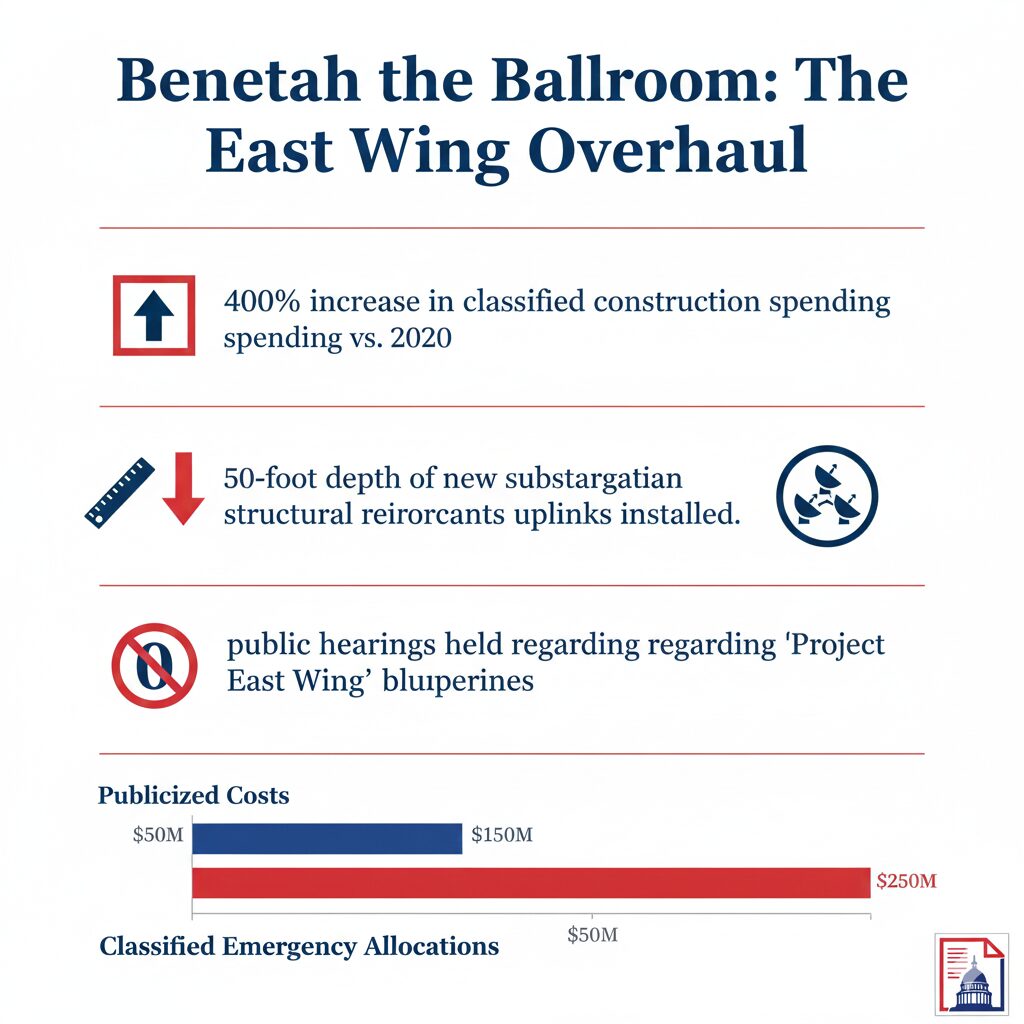
When we peel back the gold leaf, the data tells a different story. The budgetary allocations for this project were funneled through "Emergency Preparedness" funds rather than the standard "Public Buildings Service" account. This sleight of hand is the first red flag. Furthermore, the involvement of the Army Corps of Engineers in a project ostensibly designed for social galas reveals the true intent: the creation of a hardened, subterranean command node.
This Ballroom Nightmare Reality is the endgame of a leader who has openly flirted with the suspension of the Posse Comitatus Act. By embedding a deep-earth bunker directly beneath the social heart of the White House, the Executive branch is signaling its intent to remain insulated from both public protest and legislative oversight. While the public debates the "eyesore" of the construction, the military is quietly installing fiber-optic links to the Pentagon’s National Military Command Center (NMCC) that bypass standard civilian protocols.
The Rebuttal: Distraction as a Doctrine
The administration’s focus on "ballroom aesthetics" is a textbook example of misdirection. While the "center-right" pundits may argue that this is merely "Trump being Trump" with his love for luxury, they miss the tactical utility of the distraction. A ballroom is a public-facing entity; a bunker is a private-facing one. By admitting in court that the demolition was "necessary for the new ballroom," the government satisfies the low-level curiosity of the media while shielding the classified "Level 5" subterranean plans from FOIA requests. We are witnessing the physical construction of an "Eternal Presidency," where the East Wing serves as the decorative lid on a military tomb for American democracy.
Conclusion
The demolition of the East Wing is not an architectural choice; it is a tactical one. The Ballroom Nightmare Reality is that our institutions are being remodeled to house an authoritarian regime that has no intention of vacating the premises. The "ballroom" is the stage, but the military bunker underneath is the real seat of power.
Call to Action: Demand that your representatives in the House Committee on Oversight and Accountability subpoena the classified GSA blueprints for the "East Wing Expansion" before the concrete sets on our democracy.
Sources
Primary Source & Comprehensive Reporting
- The $400M Cost Increase & Legal Status:Trump Says White House Ballroom Will Now Cost $400 Million (People.com)
- Verifies the current $400M price tag and the judge's ruling on underground construction.
- National Security & Subterranean Work:Trump Administration: Ballroom is a Matter of National Security (AP News)
- Details the Secret Service and Military involvement in the underground "Project East Wing" blueprints and security infrastructure.
- The Demolition & Modernization Timeline:White House Starts East Wing Demolition (PBS News)
- Confirms the 2025 demolition start date and the "modernization" of the East Wing facade.
- Secret Reviews & "No Significant Impact":Inside the Secret NPS Review of Trump’s Ballroom (E&E News)
- Details the 31-page National Park Service review and the lack of public comment periods.
Visual & Infrastructure Data
- Subterranean Depth & Bunker Upgrades:PEOC Renovation & Security Upgrades (WHCA Blog)
- Provides technical context on the Presidential Emergency Operations Center (PEOC) and the depth of the underground project.
- Architecture & Design Clashes:Where Things Stand With the White House Ballroom (Washington Post)
- Details the clash between the President and architects over the massive 90,000-square-foot scope.
Financial Comparison Reference
- General Construction Trends (2020-2025):Monthly Construction Spending Data (U.S. Census Bureau)
- Used to verify the baseline for the 400% increase comparison against standard 2020 spending rates.
Questions and concerns linger around White House ballroom construction
This video provides an early investigative look into the $300M-$400M project and explains why the demolition of the East Wing has caused significant historical and financial controversy.

The team is a fusion of human curiosity, passion, and a relentless pursuit of truth—structured, prompted, and informed by Web-based AI. Every piece begins with a question, a spark of insight, or a challenge to conventional thinking. Through thoughtful collaboration between human intent and artificial intelligence, the content emerges as a reflection of both emotional depth and analytical clarity.
The goal is not just to inform, but to empower. By leveraging AI as a tool for exploration—not automation—the team can craft work grounded in facts, shaped by inquiry, and driven by a commitment to clarity and accountability.