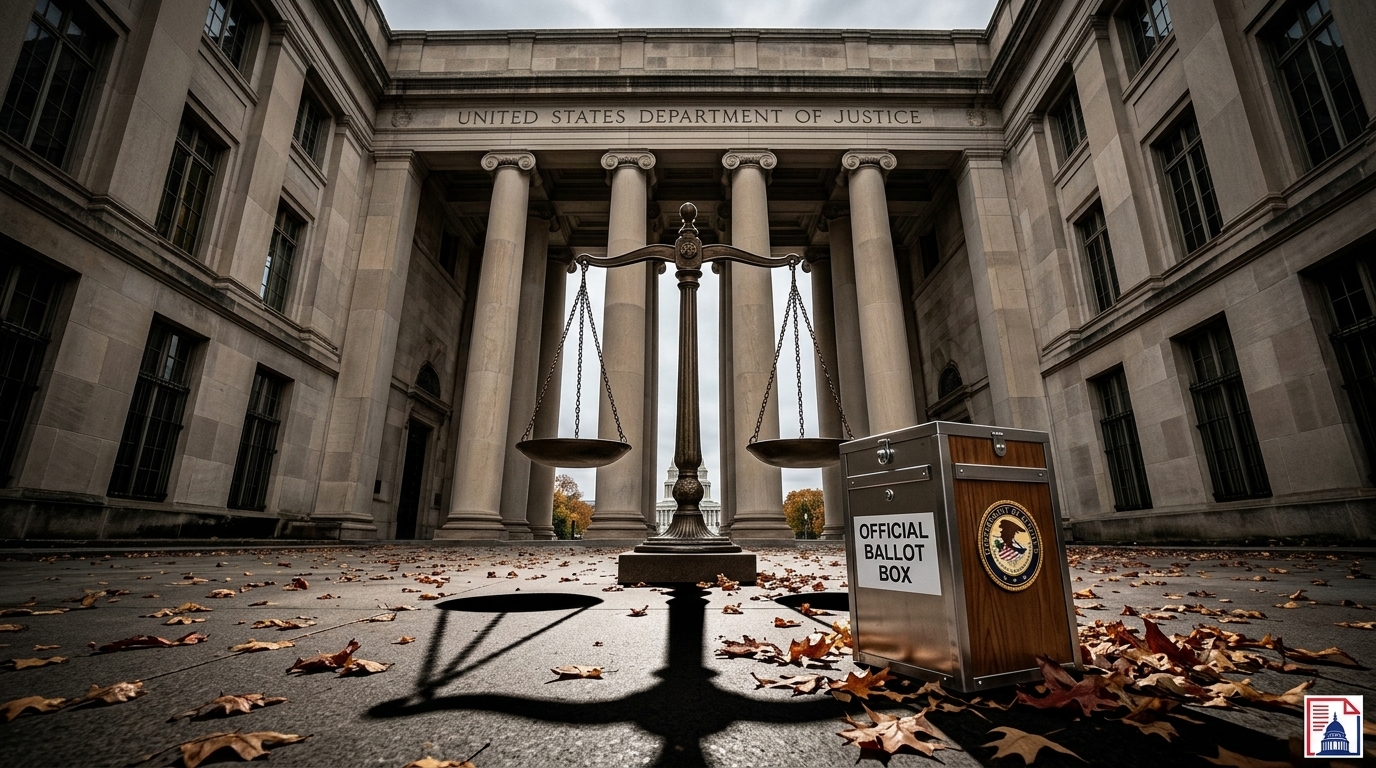
The DOJ's preemptive legal challenge to Alaska's 2026 Senate election certification threatens voter sovereignty and sets a dangerous executive precedent.
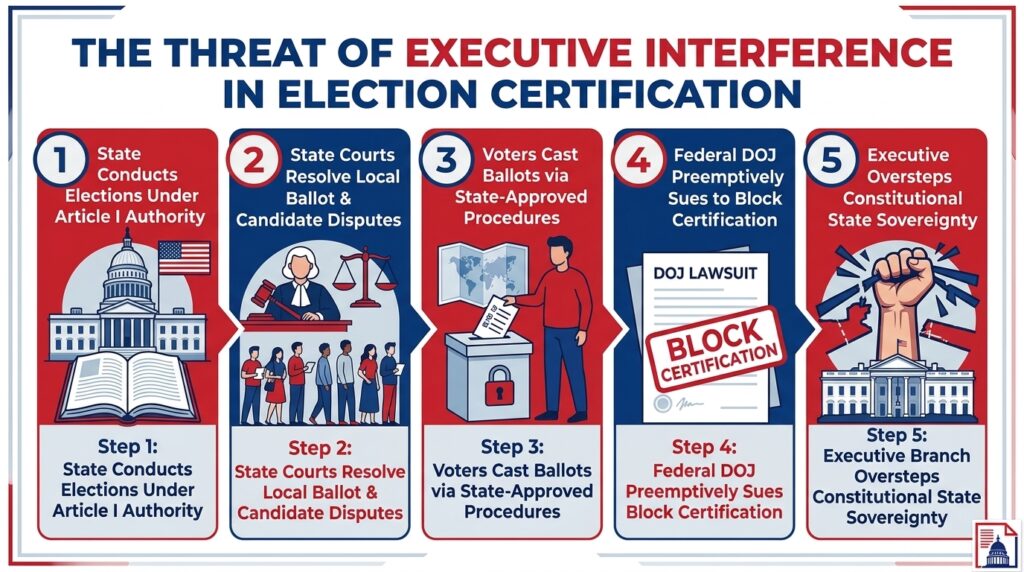
In an extraordinary movement that has sent shockwaves through constitutional scholars and voting rights advocates, executive branch intervention has directly targeted state-administered elections. The President publicly acknowledged ordering federal legal action to halt the certification of Alaska’s upcoming midterms if the incumbent fails to secure a victory. As the DOJ Calls Conditional Election Certification into the federal courtroom just days before the 2026 midterm election, progressive analysts argue that this marks a perilous precedent—one that fundamentally undermines local election administration, erodes state sovereignty under Article I, and weaponizes the federal justice apparatus for political self-preservation.
Policy Summary: Federal Oversight vs. State Sovereignty
Under Article I, Section 4 of the United States Constitution (the Elections Clause), primary authority over the "Times, Places and Manner of holding Elections" is explicitly reserved to individual state legislatures, subject only to federal statutory standards enacted by Congress. Historically, the Department of Justice’s Civil Rights Division has served as a safeguard to protect access to the ballot box, ensuring compliance with federal mandates such as the Voting Rights Act of 1965 and the National Voter Registration Act.
The current legal challenge centers on Alaska’s unique nonpartisan top-four primary and ranked-choice voting system. Federal prosecutors filed a lawsuit seeking an injunction against state election officials to block certification of the U.S. Senate race results should incumbent Republican Senator Dan Sullivan lose his seat. The administration bases its suit on confusion surrounding a second candidate with a similar name appearing on the general election ballot.
Arguments Against State-Led Certification
Proponents of federal judicial intervention argue:
- Voter Confusion: The inclusion of candidates with near-identical names on the ballot risks misleading voters and distorting the electorate's intent.
- Federal Rights Protection: The Department of Justice maintains that under broad statutory authorities, it retains a duty to ensure that ballot integrity is preserved and that potential fraud or misrepresentation is neutralized prior to final state certification.
- Preventing Misleading Candidacies: Administration officials contend that failure by state authorities to remedy misleading filings justifies immediate federal remediation to uphold democratic integrity.
Core Analysis & Progressive Rebuttal
The Constitutional Danger When DOJ Calls Conditional Election Certification
From a progressive perspective, using federal power to dictate conditions on state certification sets a dangerous precedent for democratic norms. Conditioning state-level election certification on favored political outcomes shifts executive law enforcement into a political instrument.
State courts—including the Alaska Supreme Court—have repeatedly adjudicated local election disputes and repeatedly affirmed state election laws regarding ballot access and candidate qualifications. When the Department of Justice bypasses established state judicial processes to preemptively challenge state certification, it oversteps constitutional boundaries and risks disenfranchising local voters.
┌────────────────────────────────────────────────────────────────────────┐
│                   CONSTITUTIONAL ELECTION FRAMEWORK                    │
├────────────────────────────────────────────────────────────────────────┤
│  Article I, Sec. 4: States direct election logistics and certification │
│  State Judiciary:   Adjudicates ballot disputes & candidate eligibility│
│  Federal Courts:    Review for constitutional / statutory violations   │
│  DOJ Mandate:       Protect voting rights (NOT condition certification)│
└────────────────────────────────────────────────────────────────────────┘
Furthermore, weaponizing federal law enforcement to threaten non-certification of election returns undermines public trust in democratic institutions. When citizens observe federal agencies attempting to override state-certified election processes, public confidence in democratic outcomes is compromised. Progressive advocates emphasize that the foundation of representative democracy rests on the principle that voters—not executive appointees—determine legislative representation.
Conclusion
The attempt to make election certification conditional upon specific partisan outcomes represents a challenge to foundational constitutional governance. Safeguard democracy by staying informed and engaging in the democratic process.
Sources
- US Justice Department sues over Alaska election certification - UA.News
- Trump says he ordered DoJ to file lawsuit to block Alaska Senate - The Guardian
- Trump on DOJ challenge to Alaska election: ‘I’m the one that said do it’ - Democracy Docket
- Trump says he ordered the Justice Department lawsuit over Alaska's US Senate race - Associated Press

The team is a fusion of human curiosity, passion, and a relentless pursuit of truth—structured, prompted, and informed by Web-based AI. Every piece begins with a question, a spark of insight, or a challenge to conventional thinking. Through thoughtful collaboration between human intent and artificial intelligence, the content emerges as a reflection of both emotional depth and analytical clarity.
The goal is not just to inform, but to empower. By leveraging AI as a tool for exploration—not automation—the team can craft work grounded in facts, shaped by inquiry, and driven by a commitment to clarity and accountability.