
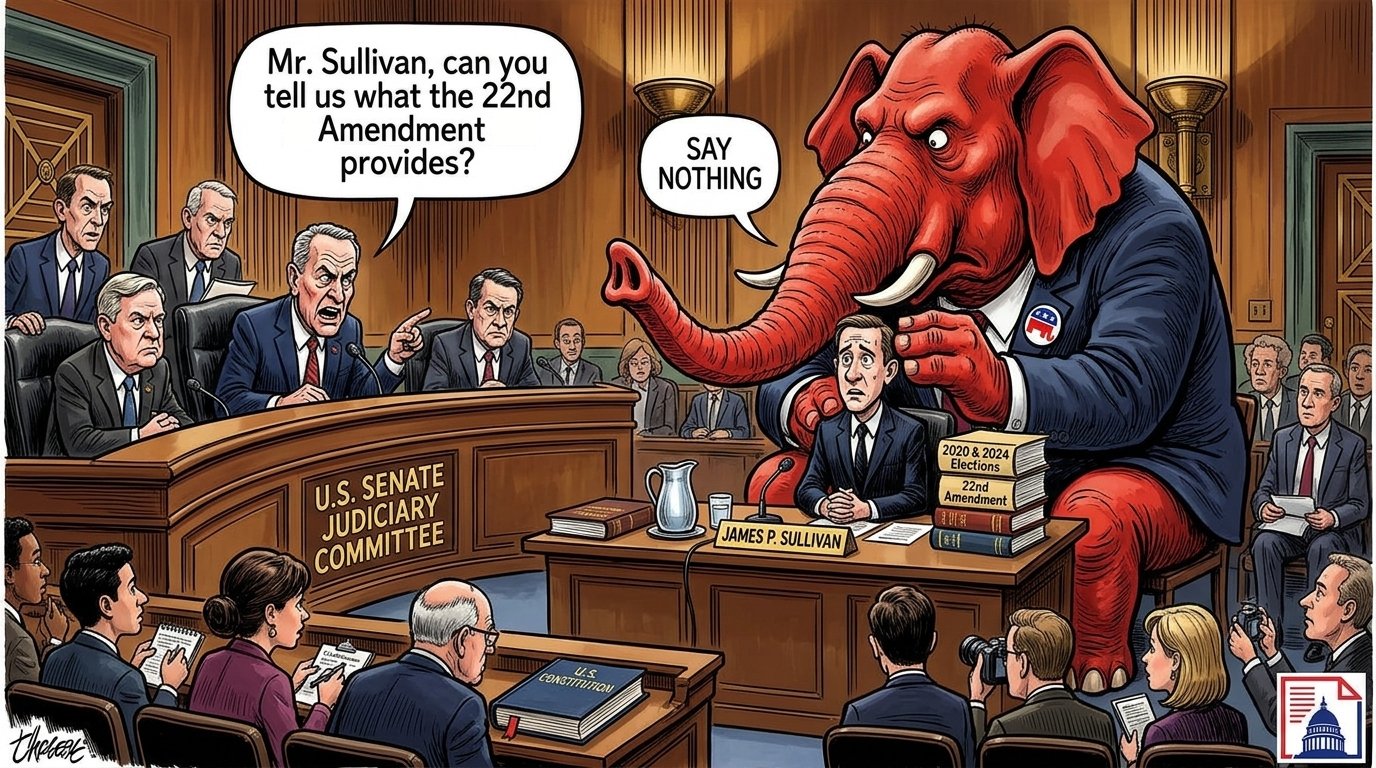
Lame-duck Senate confirmation hearings reveal a coordinated refusal among federal judicial nominees to affirm the 2020 election results or the 22nd Amendment.
During the lame-duck session of the 119th Congress, the Senate Judiciary Committee has accelerated confirmation hearings for lifetime federal judgeships. From a progressive policy perspective, these proceedings illustrate a critical institutional struggle that defines The Republican Monster: The Last Breath of an outgoing Senate majority rushing to entrench ideological allies on the federal bench before a new Democratic majority takes office in January 2027. Across recent hearings and written Questions for the Record (QFRs), nominees have repeatedly declined to state directly that President Donald Trump lost the 2020 presidential election or that the Twenty-Second Amendment bars him from seeking a third term in 2028. By invoking judicial ethics canons to avoid answering settled constitutional and historical questions, nominees are testing the boundaries of the Senate's advice-and-consent duty and raising alarms about judicial independence.
Policy Summary: The Lame-Duck Confirmation Push and Ethical Canons
Under Article II, Section 2 of the U.S. Constitution, the President nominates federal judges, and the Senate provides advice and consent before lifetime appointments under Article III take effect. Following the November 2026 midterm elections, the outgoing Senate majority has moved rapidly to process dozens of district and circuit court nominations—including recent committee markups, floor cloture motions, and confirmation votes—ahead of the 120th Congress.
During Senate Judiciary Committee hearings held in November 2026, Democratic senators pressed several judicial nominees on two foundational constitutional points:
- 2020 Presidential Election: Whether former President Joe Biden won the 2020 election outright, including the popular vote, or whether Donald Trump lost.
- The Twenty-Second Amendment: Whether President Trump, having been elected in 2016 and 2024, is constitutionally barred from running for or serving a third presidential term in 2028.
In response, nominees have adopted a uniform, carefully scripted posture. Rather than stating plainly that Biden won the 2020 election, nominees state only that "Joseph R. Biden was certified as the winner of the 2020 election" by Congress under the Twelfth Amendment, while refusing to acknowledge the popular vote outcome. Similarly, during a November 18, 2026, confirmation hearing, Texas Supreme Court Justice and U.S. District Court nominee James P. Sullivan hesitated when asked to recite the Twenty-Second Amendment by Senator Chris Coons (D-DE). Sullivan subsequently declined to answer whether Trump is eligible to run in 2028, citing Canon 5 of the American Bar Association (ABA) Model Code of Judicial Conduct. Other nominees have similarly cited Canon 3(A)(6) of the Code of Conduct for United States Judges to avoid characterizing the events of January 6, 2021, or addressing settled election outcomes.
Opposing Arguments: The Case for Judicial Restraint and Canon Compliance
Supporters of the nominees and conservative members of the Senate Judiciary Committee argue that this cautious phrasing reflects strict adherence to judicial ethics rather than partisan evasion. Their defense rests on three main pillars:
- Prohibition on Political Commentary: Proponents point to Canon 5 of the Code of Conduct, which prohibits judges and judicial candidates from making speeches for or against political candidates or engaging in partisan political activity. From this viewpoint, commenting on whether a sitting president can run in a future election crosses the line into political commentary.
- Prejudgment of Future Litigation: Under Canon 3(A)(6), a judge must avoid public comment on the merits of a pending or impending matter in any court. Defenders argue that if a legal challenge regarding ballot access, term limits, or election administration were ever filed in federal district court, a nominee who offered a definitive answer during a Senate hearing would face mandatory recusal motions.
- Precision: Supporters maintain that stating Congress certified the Electoral College votes under the Twelfth Amendment is the most legally accurate description of how a presidential election is decided under the U.S. Constitution, rendering popular-vote commentary legally irrelevant.
Core Analysis & Rebuttal: The Republican Monster: The Last Breath of Institutional Norms
From a progressive analytical standpoint, the defensive reliance on judicial ethics canons collapses upon examination of both the text of the Code of Conduct and the empirical record of the 119th Congress. Rather than protecting judicial impartiality, this coordinated reticence reveals how the confirmation process is being used to install loyalists during the final weeks of Republican Senate control.
First, the data demonstrate a sweeping, systematic pattern rather than isolated ethical caution. According to a November 2026 review of Senate Judiciary Committee transcripts and written QFRs across 69 judicial nominees, exactly zero nominees acknowledged that Joe Biden won the 2020 popular vote by more than 7 million votes, and zero acknowledged that he secured over 300 electoral votes. Furthermore, 63 of those 69 nominees invoked judicial ethics rules to avoid answering basic factual questions about the 2020 election or the January 6 Capitol attack. When 91 percent of a president's judicial slate relies on identical legalistic caveats to avoid stating verifiable historical facts, the behavior points to centralized White House vetting rather than independent judicial reasoning.
Second, invoking Canon 3(A)(6) and Canon 5 misapplies established judicial ethics standards. Canon 3(A)(6) explicitly permits judges to make public statements in the course of their official duties or to explain court procedures, and it applies only to *pending or impending* litigation—not settled historical facts from six years ago. Likewise, reciting the plain text of the Constitution is a foundational requirement for any Article III jurist, not a partisan endorsement. Ratified in 1951, the Twenty-Second Amendment states unambiguously: "No person shall be elected to the office of the President more than twice." Confirming that a two-term president cannot be elected a third time is no different from affirming that a presidential candidate must be at least 35 years old under Article II.
Third, even members of the outgoing Republican majority have raised alarms about the rushed nature of these late-term nominations. On November 18, 2026, Senator John Cornyn (R-TX) publicly blocked the nomination of Department of Justice official T. Elliot Gaiser to the U.S. District Court for the Northern District of Texas, noting that Gaiser had not been properly vetted and that the Senate must not act as a mere "rubber stamp". When nominees bypass thorough Senate vetting while refusing to affirm unambiguous constitutional limits on executive power, the public's trust in an independent judiciary is severely eroded.
Conclusion:
Lifetime appointments to the federal bench carry consequences that outlast any single administration or congressional session. When judicial nominees treat settled election results and explicit constitutional term limits as open political questions, they undermine the rule of law before ever putting on a robe. Citizens who value constitutional accountability should contact their U.S. Senators via the Capitol switchboard at (202) 224-3121 to demand that every judicial nominee affirm the plain text of the Twenty-Second Amendment and the certified facts of American elections on the record prior to any floor confirmation vote.
Sources:
* [Trump Judicial Nom. Immediately Fails Grim Live Lesson on Constitution](https://newrepublic.com/post/218153/donald-trump-judicial-nominee-fails-lesson-constitution-2028) - The New Republic
* [Texas Justice Declines to Define 22nd Amendment](https://wisevoter.com/world/us/2026/11/18/sullivan-22nd-amendment-hearing-trump-third-term) - Wisevoter
* [Arkansas justice nominated for federal appeals post questioned on 2020 presidential election](https://www.newsfromthestates.com/article/arkansas-justice-nominated-federal-appeals-post-questioned-2020-presidential-election) - News From The States
* [Nebraska federal court nominee Eric Hamilton faces criticism and support during hearing](https://www.newsfromthestates.com/article/nebraska-federal-court-nominee-eric-hamilton-faces-criticism-and-support-during-hearing) - News From The States
* [A Pattern of Evasion: How President Trump's Judicial Nominees](https://demandjustice.org/judicialreport/) - Demand Justice
* [Cornyn blocks Trump's nomination of top DOJ official to federal judge](https://www.cbsnews.com/news/john-cornyn-trump-elliot-gaiser-justice-department-federal-judge/) - CBS News
* [Senate Judiciary Committee Advances 11 Judicial and Executive Nominees](https://www.judiciary.senate.gov/press/rep/releases/senate-judiciary-committee-advances-11-judicial-and-executive-nominees) - U.S. Senate Committee on the Judiciary

The team is a fusion of human curiosity, passion, and a relentless pursuit of truth—structured, prompted, and informed by Web-based AI. Every piece begins with a question, a spark of insight, or a challenge to conventional thinking. Through thoughtful collaboration between human intent and artificial intelligence, the content emerges as a reflection of both emotional depth and analytical clarity.
The goal is not just to inform, but to empower. By leveraging AI as a tool for exploration—not automation—the team can craft work grounded in facts, shaped by inquiry, and driven by a commitment to clarity and accountability.