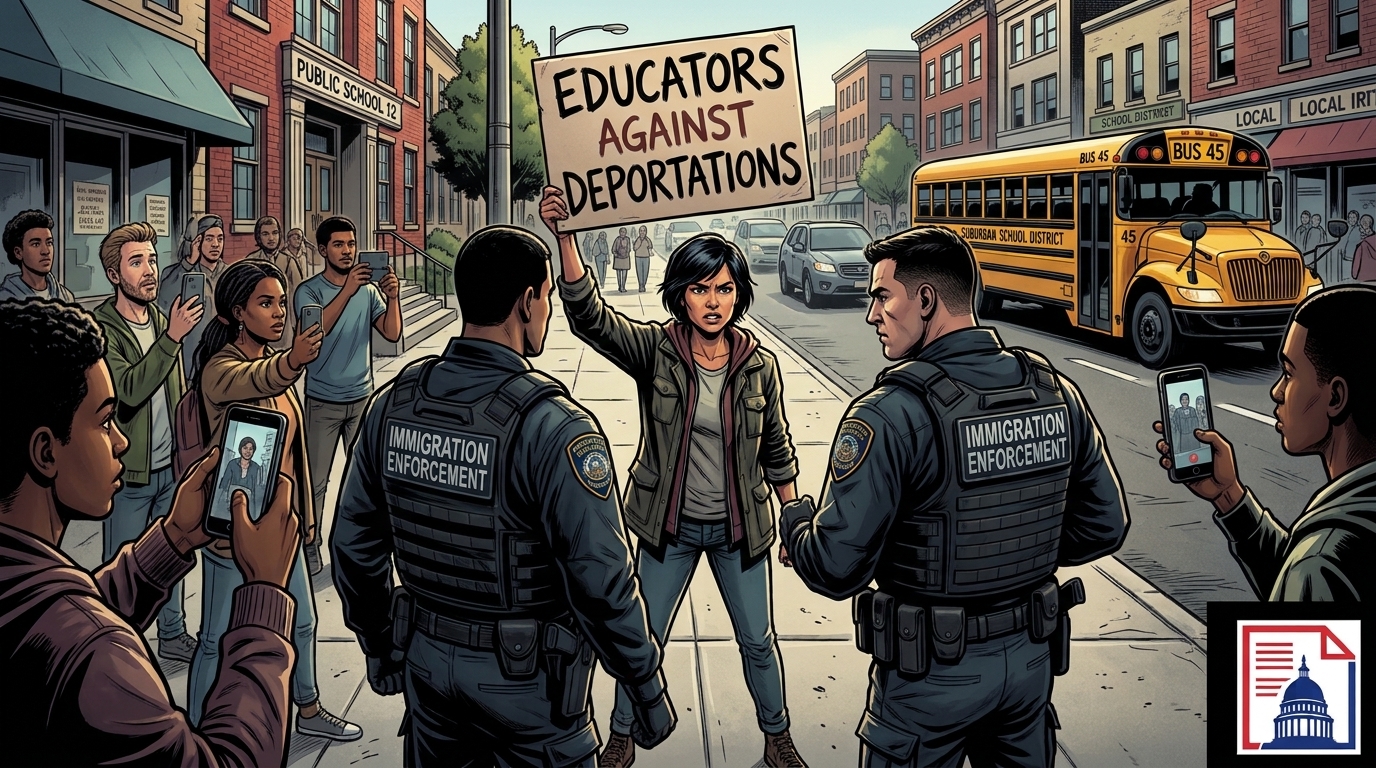
An ICE agent's violent shove against a protesting teacher underscores the urgent necessity of grassroots civil rights protections post-midterms.
The shocking footage of an **ICE agent's violent shove** targeting a local educator filming federal law enforcement activities has reignited national outrage regarding immigration enforcement tactics. Following the recent midterm elections, civil rights advocates argue that relying solely on legislative gridlock in Washington, D.C., is insufficient to protect fundamental Constitutional rights. This incident demonstrates that when federal agencies operate without adequate civilian oversight, communities must organize independently to defend their First Amendment rights and protect vulnerable neighbors.
---
Policy Summary & Context
In recent weeks, encounters between federal immigration agents and local community members filming enforcement actions have intensified across several jurisdictions. During a recent enforcement operation, a public school teacher filming from a public sidewalk was physically confronted and forcibly pushed by a federal officer. The educator sustained physical injuries, raising significant legal questions regarding Fourth Amendment search and seizure standards, First Amendment protections for recording law enforcement in public spaces, and the statutory limits of federal law enforcement authority.
Opposing Arguments & Federal Justifications
Federal law enforcement officials and defender groups maintain that officers operate in increasingly high-risk environments during field operations. The Department of Homeland Security (DHS) routinely emphasizes that operational security requires maintaining secure perimeters to prevent interference with lawful detentions and protect officer safety. Representatives for federal law enforcement argue that close proximity by onlookers and activists can create hazardous distractions, making physical redirection or perimeter enforcement necessary to prevent escalation or physical interference during delicate operations.
Core Analysis: Addressing Accountability and Accountability Deficits
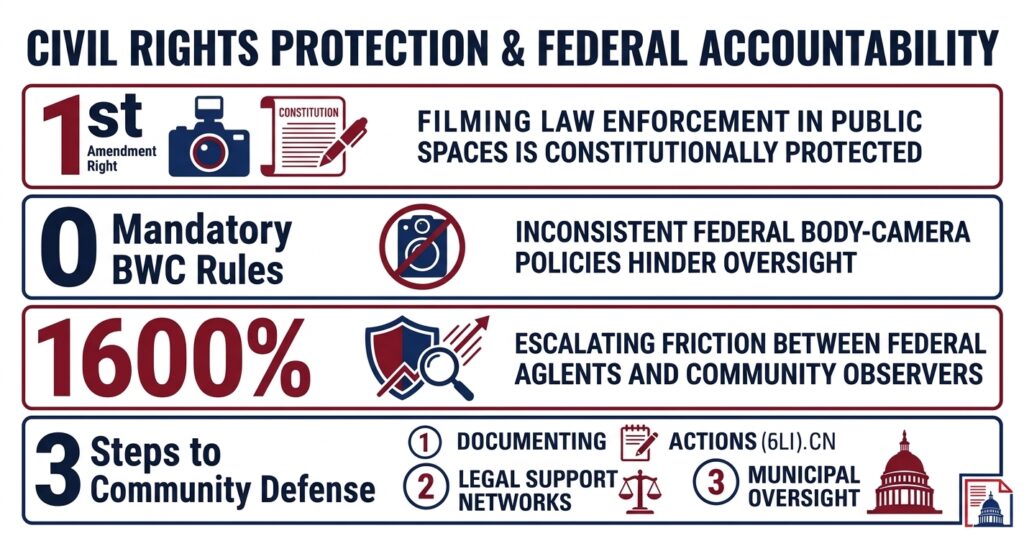
From a progressive advocacy perspective, federal justifications fail to account for the systemic lack of transparency and legal boundaries governing federal field actions. Under established federal jurisprudence (e.g., Glik v. Cunniffe), individuals possess a clearly established First Amendment right to record police officers carrying out their duties in public spaces.
Statutory analysis of federal immigration enforcement mandates highlights key policy defects:
- Qualified Immunity Protections: Federal agents often operate under broad legal protections that make civil rights litigation exceedingly difficult for injured bystanders.
- Absence of Mandatory Body-Worn Camera Requirements: Unlike local municipal police departments, federal field units operate under inconsistent transparency standards.
- Jurisdictional Conflicts with Local Oversight: Federal agencies frequently bypass local municipal consent and community oversight mechanisms.
Why Grassroots Power Matters After the ICE Agent's Violent Shove
The failure of recent congressional legislation to establish strict civilian oversight mechanisms over DHS field units illustrates the limits of relying purely on congressional action. An ICE agent's violent shove against a peaceful citizen exercise of constitutional rights demonstrates that legislative reforms must be accompanied by active community defense. Grassroots organizing, court monitoring, legal observer networks, and municipal sanctuary resolutions represent essential structural checks on unchecked executive power.
Conclusion
The physical targeting of peaceful observers by federal personnel highlights an urgent crisis of accountability. Because legislative remedies remain slow and frequently compromised in Congress, sustainable protection of constitutional liberties depends on grassroot solidarity, community legal education, and relentless public reporting.
Call-to-Action: Join local legal observer networks, support grassroots civil rights defense funds, and demand that municipal officials enact strict ordinances restricting federal law enforcement abuses in your community.
Sources
- ICE agent appears to shove woman filming Morristown raid as local police look on - Morristown Green
- ICE agents broke US citizen's arm as they detained him in California - The Guardian
- ICE agents detain teacher at Chicago daycare Rayito del Sol in North Center - CBS News

The team is a fusion of human curiosity, passion, and a relentless pursuit of truth—structured, prompted, and informed by Web-based AI. Every piece begins with a question, a spark of insight, or a challenge to conventional thinking. Through thoughtful collaboration between human intent and artificial intelligence, the content emerges as a reflection of both emotional depth and analytical clarity.
The goal is not just to inform, but to empower. By leveraging AI as a tool for exploration—not automation—the team can craft work grounded in facts, shaped by inquiry, and driven by a commitment to clarity and accountability.