

As the 119th Congress faces a record-breaking retirement wave, departing members are finally undergoing the secret procedure of Sayin "Hello Spine!"
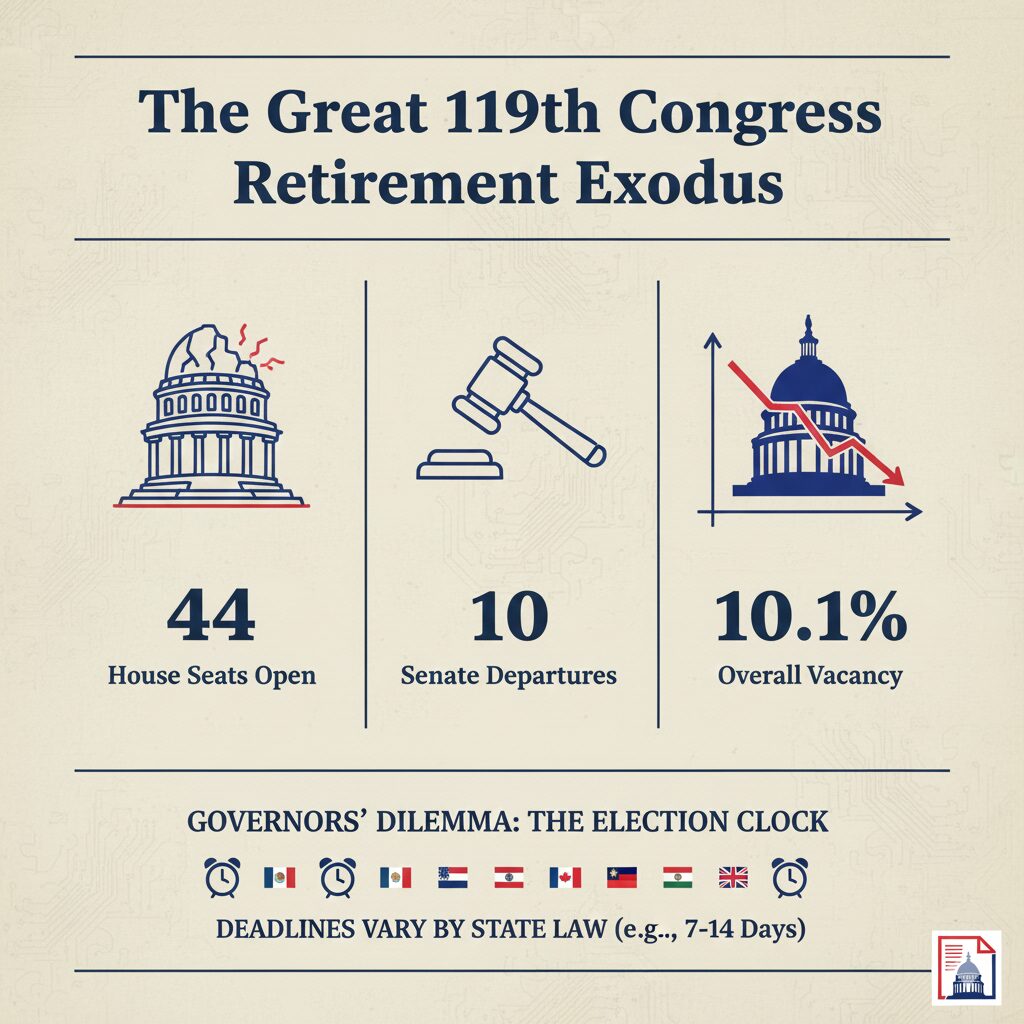
As the sun sets on the first year of the 119th Congress, the halls of the Rayburn House Office Building are filled with the sound of packing tape and the faint, rhythmic clicking of moral recalibration. With over 10% of the current legislature opting out of the 2026 midterms, the "Great GOP Exodus" of 2025 has reached a fever pitch. For many retiring Republicans, the standard out-processing—returning encrypted laptops and settling MRA accounts—is secondary to a much more delicate, private procedure. After years of tactical flexibility under the current administration, many are finally Sayin "Hello Spine!" as they prepare to re-enter a world where having a backbone is no longer a career-ending liability.
The 2025 Retirement Landscape: A Policy Summary
The sheer volume of departures in late 2025 is historically unprecedented. According to the House Press Gallery’s Casualty List, high-profile figures including former Senate Leader Mitch McConnell and even firebrand Rep. Marjorie Taylor Greene (following her public rift over the Epstein Files Transparency Act) have signaled their exit. This mass migration is driven by a combination of grueling legislative sessions—most notably the passage of the "One Big Beautiful Bill Act" (H.R. 1)—and the increasingly volatile political climate of the 47th presidency.
The Formal Exit Process
Legally, leaving Congress involves strict adherence to House Ethics Committee guidelines. Members must:
- Finalize all "Deferred Resignation" agreements under OPM-authorized programs.
- Submit final financial disclosure reports (OGE Form 278e).
- Adhere to a one-year "cooling-off" period before lobbying their former colleagues.
Opposing Perspectives on the Exodus
Critics of the departing members argue that this "retirement wave" is an abdication of duty, leaving a power vacuum during a period of significant executive expansion. Conversely, proponents—and many of the retirees themselves—suggest that the current partisan environment has rendered the legislative branch a "rubber stamp" office, where the Appropriations Committee serves more as a concierge for the executive branch than a constitutional check. They argue that leaving is the only way to preserve what remains of their personal legacies.
The Hidden Ritual: The Legislative Vertebrae Storage Act
Behind the scenes of these formal procedures lies the satirical reality of the "Spine Removal" protocol. Since the early 2020s, it has been whispered in the cloakrooms that to survive a primary in the modern GOP, one must undergo a temporary "disarticulation" of the moral compass. This procedure, colloquially known as the "Legislative Vertebrae Storage Act," allowed members to place their convictions in a climate-controlled locker at the Smithsonian for the duration of their service.
Throughout the chaotic sessions of 2025, this spinelessness was a survival mechanism. It allowed members to vote for sweeping rescissions of environmental data while simultaneously claiming to love "clean air and very large, beautiful trees." It enabled the House Ethics Committee to look the other way during the "Epstein Files" fallout, provided the right people remained redacted.
The Moment of Truth: Sayin "Hello Spine!"
For retiring Representative Barnaby Sterling (R-OH), the moment of reclamation occurred in the back of a dusty closet in his basement office. While his staff handled the cloture paperwork and the "markup" of his final farewell speech, Sterling was busy opening a velvet-lined box he hadn't touched since his first inauguration.
The Physicality of Integrity
Reinserting one's spine after years of "tactical crouching" is not without its side effects. Doctors at the Office of the Attending Physician have privately noted that many departing members suffer from "Acute Vertebral Shock." This occurs when a politician suddenly realizes they have the power to say "no" to a midnight phone call from the White House.
Sayin "Hello Spine!" is more than a physical metaphor; it is a cognitive awakening. For the first time in years, Sterling could look at a CBO score without trying to figure out how to frame a $2 trillion deficit as "fiscal restraint." He could read the Constitution without the aid of a legal team specialized in "alternative interpretations."
The Rebuttal to the "Spineless" Narrative
Defenders of the "Spine Storage" policy argue that it was the only way to keep the government functioning. "If we had kept our spines," one anonymous staffer noted, "we would have been purged in the 2024 primaries. By removing them, we stayed in the room. We weren't 'spineless'; we were 'aerodynamic' for the political winds of 2025."
However, the counter-argument remains more compelling: A representative democracy requires representatives who can stand upright. The 2025 exodus suggests that the cost of "staying in the room" has become a total loss of structural integrity.
Conclusion
The Great GOP Exodus of 2025 serves as a cautionary tale for the 120th Congress. While the formal records will show a list of resignations and retirements, the true story is found in the quiet moments of reclamation. As these members walk out of the Capitol for the last time, they are finally upright, finally vocal, and finally Sayin "Hello Spine!" The tragedy, of course, is that they only found their backbones once they were no longer in a position to use them for the American people.
Sources
- 119th United States Congress Overview - Wikipedia
- Congressional Retirement Tracker 2025 - House Press Gallery
- Memorandum on Deferred Resignation Program - U.S. Office of Personnel Management
- More than 10% of Congress won't return after 2026 - WGCU PBS & NPR
- Ballotpedia: Special elections to the 119th United States Congress — This provides the exact map of the 44 House vacancies.
- NCSL: Vacancies in the United States Congress — The authoritative source for state-by-state deadlines for Governors to issue "Writs of Election."
- Congress.gov: H.R. 4405 (Epstein Files Transparency Act) — Verifies the legislative catalyst cited for several December resignations.

The team is a fusion of human curiosity, passion, and a relentless pursuit of truth—structured, prompted, and informed by Web-based AI. Every piece begins with a question, a spark of insight, or a challenge to conventional thinking. Through thoughtful collaboration between human intent and artificial intelligence, the content emerges as a reflection of both emotional depth and analytical clarity.
The goal is not just to inform, but to empower. By leveraging AI as a tool for exploration—not automation—the team can craft work grounded in facts, shaped by inquiry, and driven by a commitment to clarity and accountability.
Leave a Reply