The 2025 Government Shutdown and Healthcare Clash is now the longest ever. The true conflict over ACA subsidies, unprecedented layoffs, and economic impact.
Healthcare Clash and Mass Layoffs
1. Introduction: The 2025 Government Shutdown and Healthcare Clash Deepens
The United States federal government entered a shutdown on October 1, 2025, at 12:01 a.m. EDT, marking the 11th such event in U.S. history. This funding lapse quickly stretched to nearly a month by late October 2025, cementing its status as the second-longest full government shutdown on record.
The core reason for this impasse is a fierce 2025 Government Shutdown and Healthcare Clash, fueled by partisan disagreements over federal spending levels, the President’s use of rescissions, and the critical issue of health insurance subsidies. The shutdown has necessitated the furlough of roughly 900,000 federal employees, while another 2 million are working without immediate pay.
2. The Partisan Stalemate: Policy Demands and Political Maneuvers
The conflict is characterized by sharp demands from both sides, particularly concerning the Affordable Care Act (ACA) and unprecedented executive actions.
Republican Strategy: Targeting Efficiency and Mass Layoffs
The Republican Party, holding the presidency and majorities in Congress, primarily sought to pass a continuing resolution (CR) to fund the government, extending funding through November 21 or into January.
The party’s position centered on:
- Refusal to Negotiate: House Speaker Mike Johnson refused to negotiate until Democrats agreed to reopen the government, arguing the House had already approved a CR.
- Healthcare Rejection: Speaker Johnson rejected Democratic demands for health insurance subsidies, labeling the issue an "impossible and inappropriate" "big facade" meant to oppose President Trump.
- Weaponizing Layoffs (RIFs): The Trump administration utilized an aggressive tactic of threatening and executing Reductions in Force (RIFs)—mass layoffs intended to permanently shrink the federal workforce, rather than temporary furloughs.
- The Office of Management and Budget (OMB) instructed agencies to prepare RIF plans for programs inconsistent with presidential priorities.
- Vice President JD Vance warned that cuts would become "deeper" the longer the shutdown persisted.
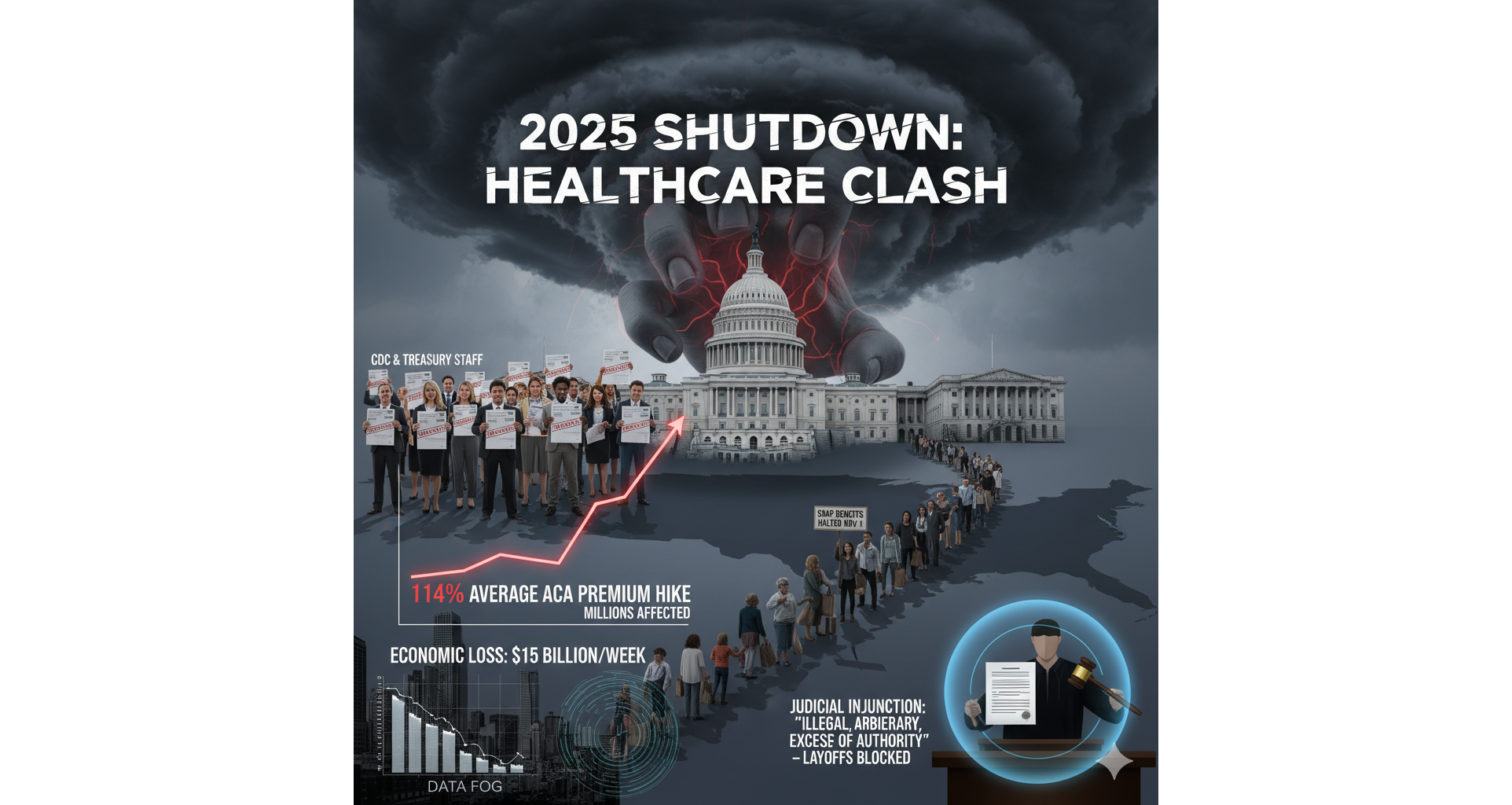
- Thousands of federal workers, including staff at the CDC and Department of the Treasury (1,446), received layoff notices in early October.
Republican messaging, including presidential statements and government websites, explicitly placed the blame for the funding lapse on "the radical left" and Democrats.
Democratic Demand: Protecting Healthcare and Resisting Executive Overreach
Democrats insisted on linking government funding to key policy items, refusing to support a "clean CR" that they argued would undermine essential programs or cede Congressional authority.
The central Democratic demands included:
- Extending ACA Subsidies: The primary demand was the permanent extension of enhanced Affordable Care Act (ACA) premium tax credits, which were scheduled to expire at the end of 2025. Letting these subsidies expire is projected to cause significant premium increases for millions of Americans.
- Reversing Medicaid Cuts: Democrats also sought to reverse previous Medicaid cuts enacted under the Republican-led One Big Beautiful Bill Act.
- Blocking RIFs: Democratic leaders condemned the administration's use of rescissions (canceling approved funding) and RIFs, arguing that a clean CR without protections would enable the administration to continue mass firings, thereby causing trauma to federal workers.
Despite pressure from the American Federation of Government Employees (AFGE), the largest federal union, urging a "clean continuing resolution," Democrats resisted, fearing that supporting the GOP CR would further expose workers to RIFs.
3. Judicial Intervention and Fact Check (Schema/List Optimization)
The political conflict generated notable misinformation and crucial legal challenges.
| Political Claim | Truth / Fact Check |
| Republican Claim: Democrats demand "free health care" for undocumented immigrants. | FALSE. The core demand was the extension of ACA subsidies benefitting enrolled Americans, not a new program for undocumented immigrants. |
| Democratic Claim: Letting ACA subsidies expire will cause premiums to "spike." | MOSTLY TRUE. Average out-of-pocket costs for enrollees are projected to rise significantly, with a revised KFF figure suggesting an average increase of 114%. |
| Republican Claim: Mass layoffs (RIFs) are necessary due to funding lapses. | JUDICIALLY DISPUTED. Federal Judge Susan Illston temporarily blocked the mass layoffs, noting that labor unions were likely to prevail on claims that the cuts were illegal, arbitrary, and in excess of executive authority. RIFs are typically permanent restructurings, making their use during a temporary shutdown highly unusual. |
| Military and Employee Pay: Federal workers and military members working during or furloughed by the shutdown will not be paid if it continues. | TRUE (delayed pay); FALSE (retroactive pay). Immediate paychecks are delayed, but the Government Employee Fair Treatment Act of 2019 guarantees that all affected personnel will receive back pay after the shutdown ends. |
4. Escalating Impacts Across the Nation
As the 2025 Government Shutdown and Healthcare Clash persisted through October, national strain increased, affecting economic stability and vulnerable populations.
Economic Fallout and Data Disruption
- Economic Cost: The shutdown costs the U.S. economy approximately $15 billion per week in lost output. The Congressional Budget Office (CBO) estimated the total GDP loss could range between $7 billion and $14 billion depending on the duration.
- "Data Fog": The availability of critical economic data was severely curtailed, creating a "data fog" that challenges the Federal Reserve's ability to assess the economy. Reports like the September jobs report, October Consumer Price Index (CPI), and the initial third-quarter Gross Domestic Product (GDP) report were delayed or possibly unissued.
Crisis for Vulnerable Populations
- SNAP Benefits: The U.S. Department of Agriculture (USDA) announced that Supplemental Nutrition Assistance Program (SNAP) benefits for over 41 million people would halt starting November 1. Over two dozen states subsequently sued the Trump administration to force the reinstatement of these benefits.
- WIC Program: The Special Supplemental Nutrition Program for Women, Infants, and Children (WIC), serving about 6.9 million participants, was also expected to pause as funding ran out.
- Healthcare Access Uncertainty: Open enrollment for ACA marketplaces began on November 1 amid significant uncertainty regarding the expiring premium subsidies, potentially leading to immediate premium spikes and coverage losses for 20 million enrollees.
The crisis remains ongoing, maintained by the deep political divide and the legal challenges surrounding the unprecedented strategy of employing RIFs against career civil servants.
Sources
- 2025 United States federal government shutdown - Wikipedia: This source provided the fundamental timeline, statistics (furlough numbers, historical ranking), partisan accusations (Trump's AI video, blame claims), and details on policy maneuvers like rescissions and the initial budget conflicts.
- Fact-checking what politicians are saying about the 2025 government shutdown | PBS News: This was essential for verifying the core issues, fact-checking the Republican claims about immigrants, substantiating the economic arguments about ACA premium increases, and contextualizing President Trump's position on presidential leadership during a shutdown.
- Judge indefinitely halts shutdown layoffs noting human toll - Central Florida Public Media: This source provided critical depth on the mass layoff (RIF) program, featuring Judge Susan Illston’s ruling and rationale, including comments on the "human toll".
- U.S. Government Shutdown Enters Fourth Week: Escalating Impacts and Partisan Stalemate Persist - SSBCrack News: This source offered a concise overview of the current status, defining the second-longest length, detailing the core demands (ACA subsidies vs. Medicaid cuts), and outlining the imminent deadlines for SNAP benefits and military pay.
- Democrats insist GOP to blame for federal workers' pain despite union urging CR passage - Colorado Politics: This provided crucial insight into the Democratic Party's internal debate and refusal to accept a "clean CR," specifically highlighting Democratic leaders' reasoning that a clean bill would expose federal workers to further RIFs and prioritize RIFs over ACA recipients.
- Judge extends order barring the Trump administration from firing federal workers during the shutdown - AP News: This reinforced the legal and political significance of the RIF injunction, detailing the administration’s legal defense based on presidential authority and election mandate.
- Impacts to Key Health Care Programs as Federal Government Shutdown Continues - www.jdsupra.com: This source was primary for outlining the direct operational impacts on the healthcare sector, including the central policy clash over ACA tax credits, the temporary halting of specialized services like Hospital-at-Home, and the economic cost estimate of approximately $15 billion per week.
- Data Fog Descends: Government Shutdown Blindsides Federal Reserve, Stalling Economic Clarity | FinancialContent: This detailed the significant economic disruption, specifically focusing on the "data fog" caused by the halt of critical government data releases (like the jobs report and CPI) which impairs the Federal Reserve's ability to assess the economy.
- US could lose between $7bn and $14bn during shutdown, budget office says: This established the official estimated total economic cost of the shutdown, citing the Congressional Budget Office (CBO) estimate of $7 billion to $14 billion in lost output, and listing the contributing factors.
- Reductions in force (RIF) during the government shutdown - Partnership for Public Service - ourpublicservice.org: This provided expert context on the unprecedented nature of using permanent Reductions in Force (RIFs) during a temporary funding lapse, detailing the OMB guidance that promoted RIFs for programs inconsistent with presidential priorities.

The team is a fusion of human curiosity, passion, and a relentless pursuit of truth—structured, prompted, and informed by Web-based AI. Every piece begins with a question, a spark of insight, or a challenge to conventional thinking. Through thoughtful collaboration between human intent and artificial intelligence, the content emerges as a reflection of both emotional depth and analytical clarity.
The goal is not just to inform, but to empower. By leveraging AI as a tool for exploration—not automation—the team can craft work grounded in facts, shaped by inquiry, and driven by a commitment to clarity and accountability.