

Four Republicans have joined Democrats to force a vote to extend ACA subsidies, protecting millions from devastating premium hikes this winter.
A Moral Breakthrough in the House
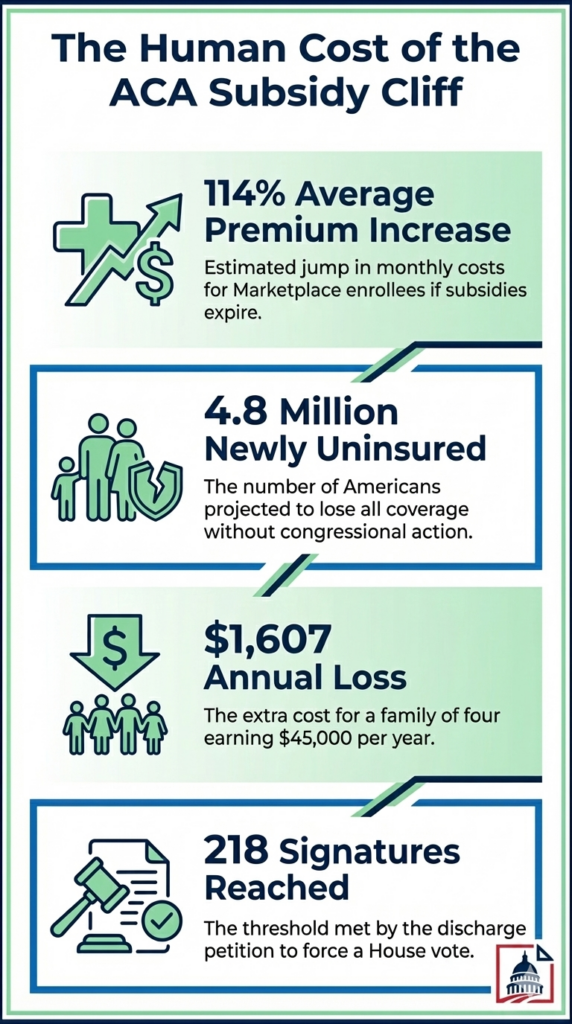
In a historic moment for health equity, the tide has turned on Capitol Hill. This week, four courageous Republicans broke ranks with their leadership to join House Democrats in a move that could save millions of families from financial ruin. By signing a discharge petition led by Minority Leader Hakeem Jeffries, these lawmakers have ensured that the House must soon vote on legislation to extend ACA subsidies before the current enhanced tax credits expire at the end of 2025.
For months, the Democratic caucus has sounded the alarm: without immediate action, 20 million Americans face an average premium spike of 114%. This breakthrough is not just a procedural win; it is a testament to the fact that while GOP leadership prioritizes partisan obstruction, the Democratic vision for universal, affordable care is winning the hearts of the American people—and even some of their representatives.
Policy Summary: The High Stakes of the "Subsidy Cliff"
The policy at the center of this battle involves the Enhanced Premium Tax Credits (eAPTCs), originally passed under the American Rescue Plan and extended through the Inflation Reduction Act. These subsidies have been the lifeblood of the Affordable Care Act's recent success, lowering premiums to $0 for many low-income earners and capping health costs at 8.5% of household income for middle-class families.
Opposing Arguments: Republican leadership, led by Speaker Mike Johnson, has consistently opposed the extension. Their argument centers on fiscal conservatism, citing a Congressional Budget Office (CBO) estimate that a three-year extension would cost approximately $64 billion. Opponents claim these subsidies "artificially" prop up a "broken" ACA market and contribute to the national deficit. Instead of extending the tax credits, the GOP recently passed the "Lower Health Care Premiums for All Americans Act," which focuses on expanding association health plans—a move critics argue would lead to "junk plans" that offer less coverage and fewer protections for pre-existing conditions.
Analysis: Why We Must Extend ACA Subsidies Now
The narrative that we "cannot afford" to protect our citizens' health is a cruel fallacy. For a family of four earning $50,000, the expiration of these credits would mean an annual cost increase of over $1,600. For older Americans in their 60s, the "subsidy cliff" is even more treacherous, potentially forcing them to spend a quarter of their income on insurance alone.
The decision by Reps. Brian Fitzpatrick (R-PA), Mike Lawler (R-NY), Rob Bresnahan (R-PA), and Ryan Mackenzie (R-PA) to join the discharge petition proves that the human cost of inaction has become politically untenable. These four members represent the growing realization that health care is not a luxury—it is a necessity. While the GOP leadership attempted a markup of their own health bill that ignored the subsidies entirely, Democrats stayed focused on the cloture and procedural tools necessary to bring real relief to the floor.
"The only policy that is worse than a clean three-year extension without any reforms is a policy of complete expiration without any bridge," noted Rep. Fitzpatrick.
This statement highlights the failure of the current House majority to lead with empathy. While Republicans focus on "market integrity" and "work requirements," Democrats are fighting to ensure that a single mother in Pennsylvania or a small business owner in New York doesn't have to choose between their medicine and their mortgage.
A Call to Action for Republican Holdouts
The success of the discharge petition forces the House to act, but the battle is far from over. The Senate, currently under a narrow GOP majority, remains a significant hurdle. However, the momentum is undeniable. We must remind every member of Congress that Democrats care about the tangible, daily struggles of the American worker.
Furthermore, the data is clear: extending these subsidies would prevent nearly 5 million people from becoming uninsured in 2026. Consequently, the pressure must now shift to the Senate. If four House Republicans can see the light, others can too. We must demand that our representatives put people over politics.
Conclusion: The Path Forward
This bipartisan breakthrough is a beacon of hope in an otherwise polarized legislative session. By forcing a vote to extend ACA subsidies, we are protecting the progress made toward universal health coverage. The Democratic party has proven once again that its priority is the well-being of the American people, not the interests of insurance giants or the ideology of the far-right.
Call-to-Action: Contact your Senator today. Tell them that the House has taken a stand for affordable health care, and the Senate must follow suit. Don't let the "subsidy cliff" become a reality for 24 million Americans.
Sources
- 4 Republicans defy Speaker Johnson to force House vote on extending ACA subsidies - Associated Press
- Four Republicans join Democrats to force vote on bill that would extend Obamacare subsidies - The Guardian
- Enhanced Premium Tax Credits: Who Benefits, How Much, and What Happens Next? - Bipartisan Policy Center
- The Door Is Closing on 'Enhanced' Affordable Care Act Subsidies - NerdWallet

The team is a fusion of human curiosity, passion, and a relentless pursuit of truth—structured, prompted, and informed by Web-based AI. Every piece begins with a question, a spark of insight, or a challenge to conventional thinking. Through thoughtful collaboration between human intent and artificial intelligence, the content emerges as a reflection of both emotional depth and analytical clarity.
The goal is not just to inform, but to empower. By leveraging AI as a tool for exploration—not automation—the team can craft work grounded in facts, shaped by inquiry, and driven by a commitment to clarity and accountability.